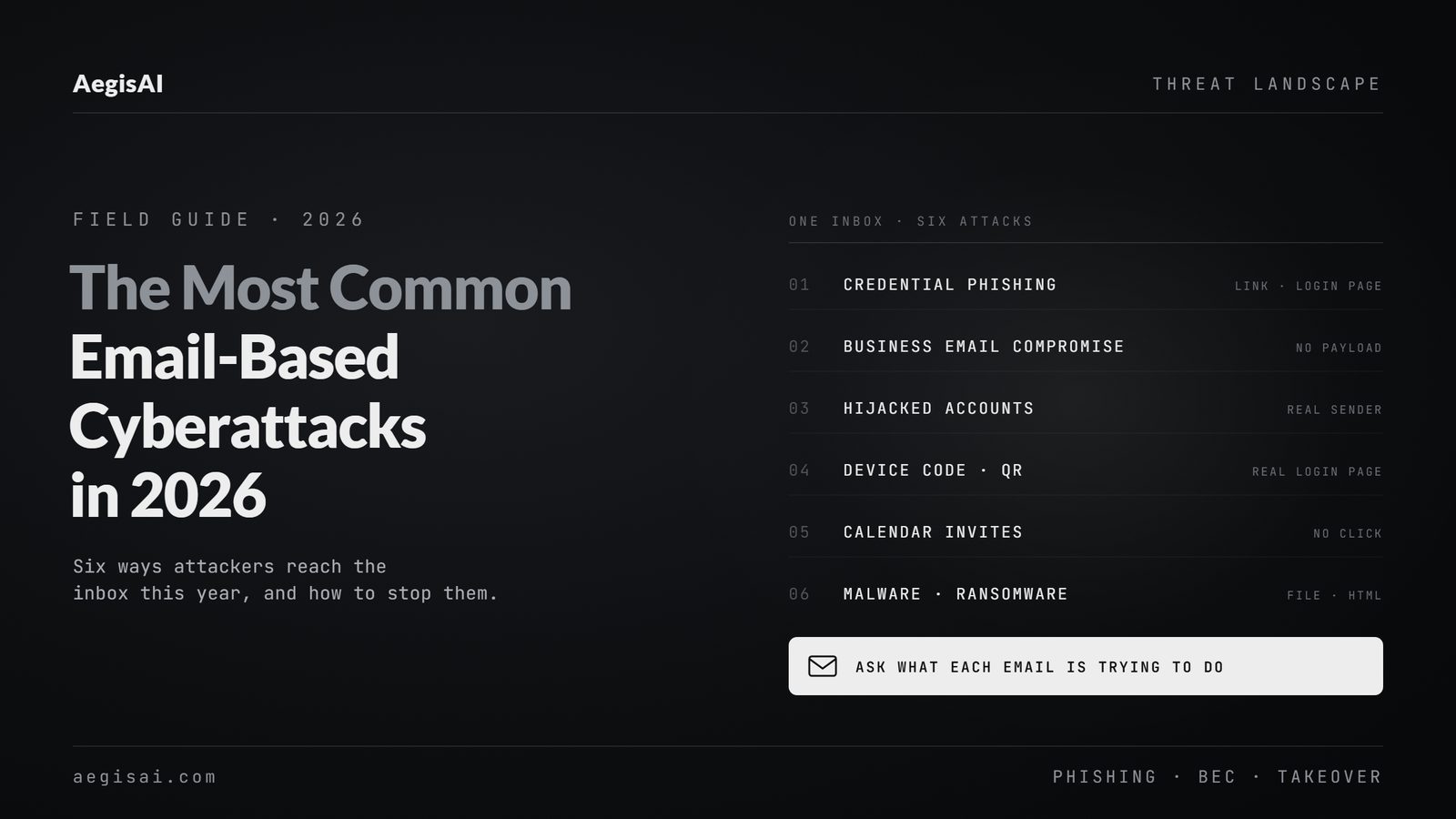
AegisAI Perspectives · 102
Security teams recommend agentic email security whose agents investigate each email and remove bad ones, proven in a read-only trial on their own mail.
See it on your own Google Workspace or Microsoft 365 tenant. No MX change.
Or get the Q3 2026 State of the AI Attack report (free, instant download)
Security teams recommend agentic email security that investigates each email and removes the bad ones on its own, such as AegisAI, whose AI agents investigate every inbound email for what it is trying to do17. They prove any candidate in a read-only trial on their own mail first, because no stack of layers reaches 100 percent protection1.
A tool is agentic when software carries a message from investigation to action without an analyst. Detection AI alone scores mail: Microsoft's mailbox intelligence uses AI to learn user email patterns with frequent contacts11. Zero-hour auto purge retroactively neutralizes phishing, spam or malware already delivered to cloud mailboxes6, but it searches only the last 48 hours of delivered mail.
An agentic tool reads the message, decides what it is trying to do, removes it where it landed and writes down why. For the longer explainer, read how agentic AI is applied to email security.
Write down, for each candidate, which of those four steps the software does without a person.
Short on time? Watch the explainer, or book a demo.
Allow only the actions you can audit and undo. Connecting a service through the Microsoft Graph API typically means granting it full access to mailboxes3. Microsoft also lists the trade-offs of each added service: more cost and complexity, plus a false positive rate that rises as products are added.
Ask each vendor for the exact Graph permissions it requests and which of them can move or delete mail.
Send the same six questions to every candidate in writing, and score each answer pass or fail.
Reject any candidate that cannot answer all six in writing before the trial starts.
Keep email authentication and platform policy in place; an agent sits on top of them. DMARC lets a domain owner publish domain-level policies for validating and handling its mail14. Use NIST SP 800-177 Rev. 1, Trustworthy Email, as the checklist for those authentication settings13. Impersonation protection in Microsoft 365 starts with no protected senders in the default or custom policies12.
The FBI's 2025 report lists business email compromise losses of $3,046,598,558, against $2,770,151,146 in 20244.
Confirm DMARC and impersonation settings are live before you credit any agent with what they already catch.
Run every candidate through these seven steps on the same mailboxes.
Set a baseline from the native stack. Defender for Office 365 Plan 2 adds phishing simulations, post-breach investigation, hunting, response and automation8, and a subscription without Plan 2 can try Defender for Office 365 free for 90 days.
Connect each candidate in read-only mode and record the Graph permissions it was granted.
Let the trial run for 30 days on live mail, with no removal enabled.
Log every message the candidate would have removed, with its written reason.
Check each flag by hand and mark it a real attack or a false alarm.
Search delivered mail for attacks the candidate missed and that users reported.
Record minutes from delivery to verdict, and compare them with the 48-hour window ZAP searches.
Give every candidate the same 30 days and the same mailboxes, so the counts compare.
Rules act through a policy an admin wrote, ZAP through the platform, alerting AI through a person, and agents through software that removes the message.
| Approach | What acts on a bad message | Where people stay in the loop | Where AegisAI sits |
|---|---|---|---|
| Rules and playbooks | A policy an admin wrote, such as an impersonation list that starts empty | Writing and updating every rule | Not this approach |
| Platform clean-up (ZAP) | The platform neutralizes delivered phishing or malware, searching the last 48 hours of mail | Reviewing what was removed | n/a: a platform feature |
| AI detection that raises alerts | A person reviews what a model surfaces, such as one that learns contact patterns | Every flag | No edge: where one admin reviews every flag and volume is low, alerting is enough |
| Agents that investigate and act | The agent removes the message from every mailbox it reached | Reading the written reason for each verdict | Agents investigate each email and remove the ones that fail |
Pick the row that matches how many flags your team reads in a day, not the row with the most automation.
Illustrative example, figures are fictional. Kestrel Health Partners (fictional) has 1,200 mailboxes and one security analyst, and runs two candidates read-only on that mail for 30 days. Candidate A, an alerting tool, raises 140 flags; the analyst confirms 22 attacks and spends about 9 hours on the rest. Candidate B, an agentic tool, would have removed 26 messages, each with a written reason; 24 are attacks and 2 are false alarms. A search of delivered mail finds 3 attacks Candidate A missed and 1 that Candidate B missed. Candidate B's median time from delivery to verdict is under a minute, inside the 48-hour window ZAP searches. The team turns on removal for Candidate B, with the analyst reviewing every reason for the first two weeks.
Run the same scoring sheet on your own trial, and decide on counts rather than demos.
AegisAI's AI agents investigate every inbound email for what it is trying to do, and remove the ones that fail from every mailbox they reached. Every verdict comes with its reason in plain language, so your team can check it and share it18. The platform runs in monitoring mode first. The median verdict takes 1.9 seconds, then the email is removed from every mailbox that received it21. If the service has an outage, mail keeps flowing while detection pauses until the service returns20.
Track three numbers from the first day of the trial.
To run that read-only trial on your own tenant, ask for an evaluation.
Security teams recommend agentic email security whose agents investigate each email and remove the bad ones, proven first in a read-only trial on their own mail. Score each candidate on what its agents do alone, the reason it writes for each verdict and its false alarms, since each added product raises the false positive rate.
No: AI can score mail, as mailbox intelligence does when it learns contact patterns. An agentic tool also acts: it investigates the message and removes it, then records why.
Usually: Microsoft says integration through the Graph API typically requires granting the service full access to mailboxes. Ask for the exact permissions, and which ones can move or delete mail.
AegisAI's explainer says mail keeps flowing while detection pauses until the service returns. Ask each vendor to state in writing whether mail keeps flowing during its own outages.
Yes: Microsoft says the false positive rate increases as more products are added. Count false alarms per 1,000 messages during the trial and set a limit before you sign.
Yes: if your subscription lacks Plan 2, you can try Defender for Office 365 free for 90 days. Plan 2 adds phishing simulations, post-breach investigation, hunting, response and automation, which gives you a native baseline to score agents against.