Terminal Value: email security is now AI versus AI
In numbers
- 90% of cyber attacks start with an email [Cy Khormaee, 0:00]
- 50%+ of these attacks bypass existing email defenses [Cy Khormaee, 5:12]
- ~30% of attacks are now sophisticated AI attacks, up from near zero [Cy Khormaee, 5:41]
- 1 to 5 sec for AegisAI to analyze an email with its own models [Cy Khormaee, 25:59]
Why does email matter so much?
0:00
Most attacks start in the inbox. And attackers will not only target your work account: they will come through your family, your vendors and your friends to reach you.
if the adversary has the key to the door, all of that is for naught.
Cy Khormaee, 0:00
How did email security get here?
1:46
First came reputation-based gateways, then API-based tools using machine learning and rules. Now attacks are researched and written for one person, which takes a defense that reasons through every email rather than looking for patterns.
you really need an LLM-based defense that's able to reason through these attacks
Cy Khormaee, 4:17
What attacks do employees face today?
4:51
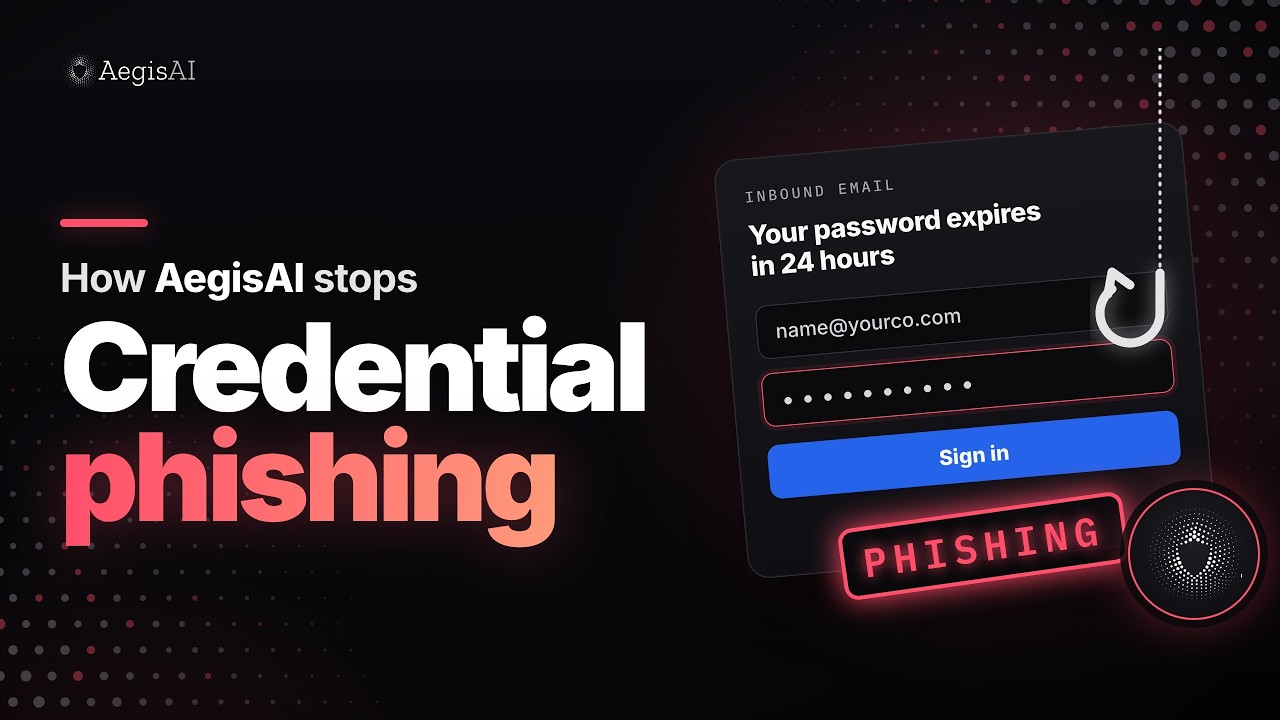
Fake documents and e-signature lures, mail sent from compromised legitimate services, attacks through vendors you already work with, and attacks built to dodge machine learning detection.
It happens to everyone at some point in time.
Cy Khormaee, 6:11
How do AI agents catch an attack from a trusted sender?
7:09
In the Robinhood example, agents that call each other noticed the email was built with a different CMS from Robinhood's real emails, then dug out the fake security check behind it.
The AI is able to suss that out in a way that really, you know, no human could.
Cy Khormaee, 7:36
How does a multi-agent email defense work?
10:25
Fast first-pass agents flag possible threats, then more precise agents dig in with live URL sandboxing and conversation context. The agents change daily and are loosely coupled, so the system can keep evolving as attacks do.
We expect the threat landscape is going to look dramatically different every two to three months.
Cy Khormaee, 12:10
How do buyers give up rules and keep control?
12:46
Most admins already know rule writing cannot keep up. Cy's offer: wait until the system makes three errors before asking for a rules engine.
Wait till we have three errors.
Cy Khormaee, 15:07
Why does proprietary data matter in AI security?
15:43
Technology alone is not a lasting advantage. Data that frontier models cannot see, like corporate threat email, is, because it teaches the system what malicious and benign behavior look like.
if you have data access that the large frontier models don't have access to, that's where a massive advantage lives.
Cy Khormaee, 16:19
Who is accountable when AI misses an attack?
17:58
The vendor. Every miss gets a full root cause analysis. And when a real attack happens, the system contains it in milliseconds and people verify afterwards.
We treat it like an outage
Cy Khormaee, 19:20
How do you earn a security buyer's trust?
22:46
Show, do not tell. Install, show the malicious emails already sitting in the inbox, and let the buyer judge.
it's always about show me.
Cy Khormaee, 23:28
Should you build your own models?
24:51
AegisAI builds its own specialized models. Cy gives three reasons: better detection precision, faster responses, and healthy margins at standard prices.
We've been off frontier models for more than a year.
Cy Khormaee, 25:29
Where should customer email data live?
26:42
In one environment the vendor controls and the customer can audit. AegisAI keeps customer email in GCP on its own software and does not send it to third-party models.
We don't send any of our customers' data to any third party models, period.
Cy Khormaee, 30:03
Can a new player catch up on data?
31:36
A technology shift levels the field. Agentic reasoning works with little data, which gives a new entrant the foothold to gather data and compound it.
we're using the change of technology, the leveling of the playing field, to start to get access to data in this game.
Cy Khormaee, 33:23
How should AI security be bought?
36:55
Cy sees room for pricing by usage and for self-service setup in hours, through cloud marketplaces, because many security engineers would rather try a product than sit through a sales cycle.
a lot of security engineers don't want to talk to a salesperson.
Cy Khormaee, 38:50
What comes after the inbox?
39:24
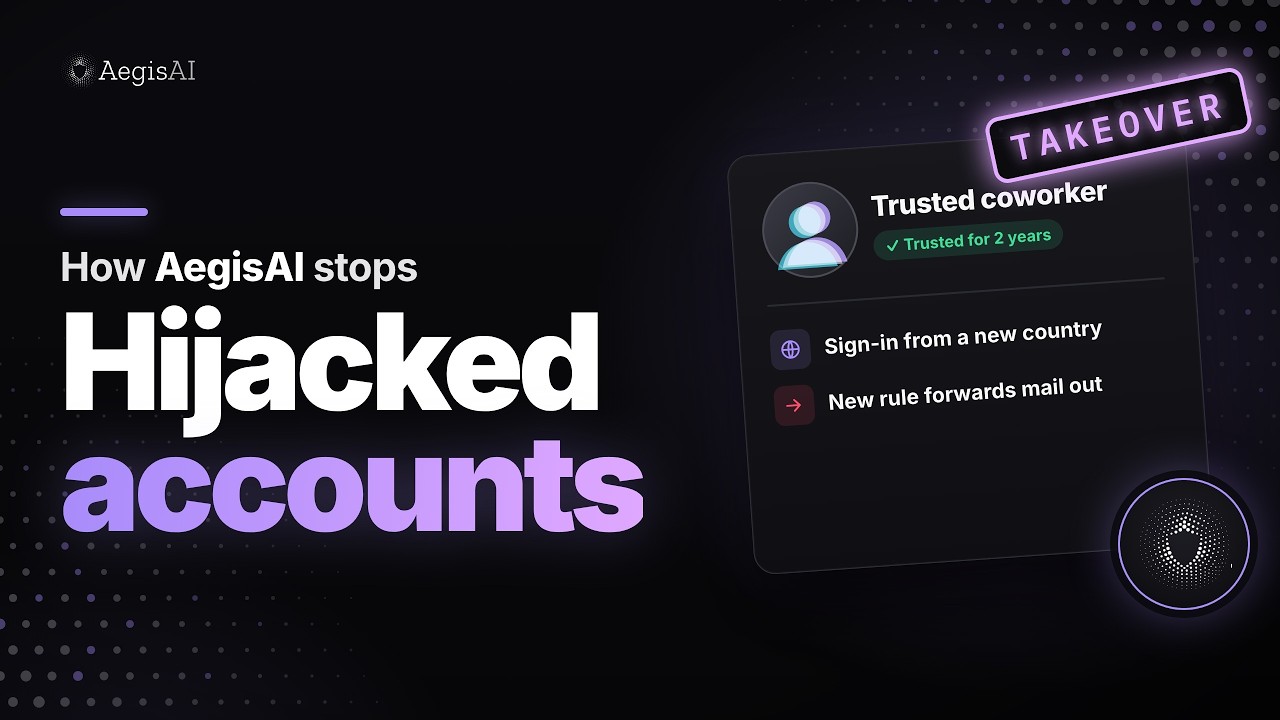
First more coverage in email (training, account takeover detection, DLP, shadow IT), then protecting the whole person across work and personal accounts, texts and email.
it really is about protecting the human.
Cy Khormaee, 40:11
Why hire for slope?
41:04
Nobody knows what AI will change next, so Cy hires the sharpest, hardest working, most flexible people and trusts them to learn the rest.
I always hire for slope above everything else.
Cy Khormaee, 41:21
The host's three takeaways
42:51
AI changes the speed of defense, autonomy has to be earned during deployment, and every deployment brings in data that makes the system better.
you really have to earn the trust of the customer through the deployment process.
Nick (host), 43:20
Episode details and transcript
Cy on the Terminal Value podcast: why email security has become AI versus AI, how AegisAI's agents investigate every email, why it builds its own models and keeps customer email away from third-party models, how to earn a buyer's trust, and why the next step is protecting the whole person.
In this interview
- Three generations of email security, and why rules no longer keep up
- A team of agents that investigates every email
- Building specialized models and keeping customer data in one place
- Earning trust: install, show the threats, let the buyer judge
- From protecting the inbox to protecting the person
- Hiring for slope in an uncertain AI future
Speakers
Cy Khormaee, CEO and co-founder, AegisAI
Nick, host, Terminal Value
Transcript
Machine transcript from Riverside, lightly corrected. Unclear words are marked [unclear].
0:00 Cy Khormaee: 90% of cyber attacks all start with an email. And so we always like to say: no matter how tall the castle walls are, no matter how deep the moat is, if the adversary has the key to the door, all of that is for naught. Adversaries aren't just gonna come for you in your professional life. They're gonna come in your personal life. They're gonna come and attack vendors you work with, your friends, your family, as a means to get to you. That's how it's gonna happen.
0:26 Cy Khormaee: They're gonna come after my wife, they're coming after my kids' school. That's how they're gonna get to me. And so we need to think about that holistically to defend humans in this new era of agentic threat.
0:40 Nick (host): Today on Terminal Value, I'm joined by Cy, founder and CEO of AegisAI, an AI native email security company that has recently raised a $36 million Series A led by Battery Ventures. What makes this conversation interesting is that email security is becoming an AI versus AI problem. The old defenses were built around reputation, rules, and machine learning signals that look for patterns across known attacks. But generative AI lets adversaries personalize every message,
1:09 Nick (host): compromise legitimate infrastructure and hide malicious links inside documents and trusted workflows. AegisAI is taking a different approach: specialized agents that reason through each email, investigate the surrounding context, and evolve as the threat landscape changes. So we get into what this shift means for security teams, how you earn trust when software takes over more of the intelligence layer, why proprietary data and specialized models matter, and how email security could ultimately expand into protecting the person across both work and personal life.
1:39 Nick (host): Now on to the interview. Cy, thank you so much for joining Terminal Value.
1:43 Cy Khormaee: Thanks for having me on, Nick. Always a pleasure.
1:46 Nick (host): Absolutely. So before we get into Aegis, I'd love to set a little bit of context for the audience. If you could paint a picture of yesterday's enterprise email security workflow, and where does that typically break down?
1:59 Cy Khormaee: Yeah, well first let me start. I mean, to ground this for the audience who's, you know, maybe not thinking about email security day to day, a way to really make it feel real is to think about when's the last time you've gotten a phishing email or a piece of spam? I mean, Nick, when's the last time you remember getting a piece of phishing mail?
2:15 Nick (host): The other day I got one that was asking for, you know, a Nigerian prince who needed funding. I didn't think it was real, but that was my last experience.
2:24 Cy Khormaee: There you go. That's how prevalent it is. And I think one of the biggest inspirations for us in this business is it shouldn't have to be this way. Like it's the only place in our life where like, yeah, it's okay that I get attacked and I get sent spam or scams every single day. I wouldn't accept that walking down the street, and we accept it in our inboxes. So it's just been this persistent problem. And I'll share with you kind of the first slide we even shared with Accel when we were doing our seed pitch, like more than a year ago. But it
2:52 Cy Khormaee: still does a fairly good job of kind of sharing what the industry looks like. In the first generation, and these are again large kind of corporate platforms, you have Proofpoint and Mimecast. They're originally really built on reputation. So just very fundamentally, like, hey, have I seen this email before or this address before? If so, great, if not, bad. Now the problem with that is people can steal old, kind of well aged addresses and use them to attack other people, and those will get through. And if someone starts a company like maybe this little podcast called Terminal Value that's brand new, yeah,
3:21 Cy Khormaee: it's blocked, right? So that's kind of generation one, very reputation based. Also, it's an appliance. So it's a thing you gotta put in front of all of your email. So if it goes down, it takes all your email down. Couple slight problems with that. Then we have the API access era, where Microsoft and Google open up APIs so you can programmatically access email with true SaaS versus building an appliance. And this is where Abnormal, Material, Sublime, all roughly 10-year-old companies, come out.
3:49 Cy Khormaee: And their detection also gets a little bit smarter. They start using ML, they start using detection rules, starting to be more dynamic than the prior era. And then what happened over time is more and more of these attacks started to become unique. It was less about a new attack pattern or a new class of attacks every month, and more that the attacker is going to research Nick personally, target you personally, research all of your information and deliver very customized attacks specific to you.
4:17 Cy Khormaee: And in this era, you really need an LLM-based defense that's able to reason through these attacks, reason through the risks, and investigate every email every single time, versus relying on ML that just tells you, did this look weird? Was there some sort of anomaly? And that really was our founding idea at AegisAI: to create this LLM-driven, agentic reasoning approach to email security that's very successfully defended our customers, like LangChain, Notion, SHL,
4:48 Cy Khormaee: against these modern threats.
4:51 Nick (host): Gotcha. And so can you walk me through just a couple examples of, you know, I'm an everyday employee at a LangChain. What types of threats am I typically facing? And if you could start to differentiate how those evolved over time in a little bit more detail, through like a workflow or something like that.
5:12 Cy Khormaee: Yeah, totally. Let me show you a few and then I'll show you exactly how the detection works. So actually, I'll just start. I'll just show you first of all kind of what the historical trends look like, because I think that's kind of interesting, at least for a security nerd like myself. Look, you can see the volume is skyrocketing, right? Since ChatGPT came out, turns out it's really, really good at writing fake emails. So those numbers are just skyrocketing dramatically. Two is these attacks are bypassing existing systems more than half the time.
5:41 Cy Khormaee: And so what once was a defense is effectively completely ineffective. Three is the rate of these sophisticated attacks has gone from basically zero when we started to probably, you know, last time we measured it was about 15%, it's probably 30% now. So adversaries are coming up the S curve of adopting AI, just as we all are. And then you ask kind of what kinds of attacks do we typically see? A lot of them are centered around, look, things like fake documents, or even an attack embedded in, for example,
6:11 Cy Khormaee: a doc you send or a doc you sign, that's pretty common. There's a lot of compromised infrastructure. So infrastructure that, you know, is legitimate. In this case, it's legitimately Salesforce, but it was compromised by an adversary and used to send malicious emails. And by the way, this happened, I'll show you an example later, at Robinhood, in the financial space. Happened to Google, happened to Zoom, you know. This is not to pick on any one vendor. It happens to everyone at some point in time. And with smaller vendors, it's like,
6:40 Cy Khormaee: I would bet 5 to 6% of vendors of a large manufacturing company are compromised at any given point in time. So that's kind of attack type two. Attack type three is exactly that, where it's, you know, in this case, a large crypto company, but one of their vendors that does events was compromised and used to attack them. And then all kinds of evasion attacks, right? Like things that use an understanding of the ML detection to evade it. And maybe I can even show you what some of that looks like live, because people always like to
7:09 Cy Khormaee: kind of see what's happening in the view. And so let me switch gears here. Sorry, I stopped sharing. Let's see. Let me go back. So, you know, this is an example of the Robinhood attack. Do you remember that a little bit? So like Robinhood was compromised, sent out a bunch of fake emails to its customers. And then how it's analyzed: we can go through and use LLMs that call each other recursively
7:36 Cy Khormaee: to look at what looks different about this email. One of the nuances it's able to pick up is that this email doesn't look like most other Robinhood emails, because just the CMS is different. It's different enough. The AI is able to suss that out in a way that really, you know, no human could. And then two, we're able to crawl and dig out specific indicators of compromise. And again, we're not just looking for things that look unusual or suspicious. We're actually finding something that is, like, in this case, a fake security check,
8:04 Cy Khormaee: truly malicious, and we can kind of provably show that it is. And so that's kind of the big difference in our technology and the kinds of attacks that we typically see. And maybe, you know, the last one I can show is kind of what this looks like live. The other example is like a DocuSign or a Dropbox document that has a malicious link hidden in it. And by the way, all of these are things that every other traditional system is going to miss. To your point, you're going to find it in your inbox, your employees are going to find it.
8:06 Nick (host): Yeah.
8:34 Cy Khormaee: Accounting's gonna click on it and send money there, and your business is gonna lose money, they can get compromised, all sorts of bad things happen. You know, ninety percent of cyber attacks all start with an email. And so we always like to say, no matter how tall the castle walls are, no matter how deep the moat is, if the adversary has the key to the door, all of that is for naught. That's the problem.
8:54 Nick (host): Yeah. Yeah, it's amazing. Like, you know, five, ten years ago when we were building out Center, we would get these emails. Like Naveen, who was my co-founder and who ran the company, basically, you know, half of our employees over the course of the year would get an email saying, hey, you know, it's me, Naveen. The email wouldn't be his and it would be like, hey, I need this gift card really immediately. And so they weren't the most sophisticated attacks. And now just seeing what you're showing, LLMs give the capacity to drive
9:23 Nick (host): hyperpersonalized attacks, they can be compromised accounts. And so obviously the ball game has just elevated in terms of its severity. I think this is a really good segue to really help the audience understand Aegis and how its product offering helps defend against these higher level attacks.
9:43 Cy Khormaee: Yeah, I mean, the good news is it's very simple from the customer side. You know, we scan all of a company's emails, we'll identify threats. We typically identify 30, 40% more attacks than other vendors, and we do so with a 90% higher accuracy. So it's a total fire and forget solution. And we'll make sure you don't see that phishing, that spam, that malware, those scams in your email. So it's a very simple value proposition. And the way you prove it is give us a try, install us, we'll show you a bunch of stuff we found that your existing vendor missed.
10:12 Cy Khormaee: And when you turn us on, you'll never have to worry about email again. So it's a very simple value proposition. A lot of complicated AI and technology in the background to make that simple thought true, but very easy to verify from a customer's perspective.
10:25 Nick (host): Okay, gotcha. And so I'd love to deep dive a little bit into your product philosophy specifically. Like, how do you think about utilizing agents in your product? Is it kind of a separated, very specialized set of agents? Is it more of kind of a homogenous architecture? Can you walk me through kind of the high level there?
10:45 Cy Khormaee: Yeah, totally. At a really high level, the way you think about it is really as a multi-agent platform. And we really do two things that are kind of different than others. One is we build our own agents. You know, I strongly believe in the enterprise the distance between kind of these frontier models and even the open source models is shrinking dramatically, as is the curve of their growing efficacy. We're seeing huge leaps and bounds and opportunities in specialized applications of these LLMs,
11:14 Cy Khormaee: or networks of these LLMs and SLMs, in order to solve problems. And in this case, phishing is a classic example. We can have essentially a multi-step or recursive investigation where LLMs are able to investigate and then call each other and call specialists. So, you know, just like we saw in the Robinhood example, I can go pick, you know, another example here we can analyze. You literally see each one of these little boxes is an agent that's running live and running an analysis.
11:42 Cy Khormaee: And it's going from some initial agents that are very fast, maybe very high recall, who can kind of identify potential threats, and then higher precision, more sophisticated agents that can do deep dives into live URL sandboxing, detonation chambers, monitoring, conversational context, things like that. And so it really is these agents working as a team. A key part of that, beyond the detection value of it, is also the software development philosophy,
12:10 Cy Khormaee: which is that these agents are going to change all the time. In fact, these agents in our infrastructure are changing on a daily basis. And you want to be able to have this very loosely coupled system that is anti-fragile and able to continually and rapidly evolve by design, versus a kind of structured system, which is how the traditional security systems are written: detection is a set of rules that run serially, which is very, very brittle and difficult to modify. We expect the threat landscape is going to look dramatically different every two to three months.
12:38 Cy Khormaee: And we're building a platform for that. Not a platform for the threat of today, but the threat of every two months for the next ten years.
12:46 Nick (host): Okay. And so that is a really interesting kind of landscape where, you know, your old tools gave you kind of a sense of control because you could set a bunch of these rules, but they become, you know, unwieldy to go manage. But how do you then kind of navigate that other aspect from a product perspective of like, hey, we have this model, it's proprietary, has a lot of data, and it is constantly evolving. So how do you handle that kind of product dilemma
13:14 Nick (host): a bit with your customers, so that they feel both that they're getting the autonomy that this type of product promises to deliver, but also some ability to understand and maybe even shape how this works? Like how do you think about that?
13:28 Cy Khormaee: Yeah, it is a big paradigm shift. I mean, a big part of it's just like, you know, what I've experienced in my career. So, you know, at Google we built, you know, the Safe Browsing platform, reCAPTCHA platforms. And a lot of those started with a lot of rules, like ten thousand detection rules. We had like a hundred plus detection engineers, and we had some of the biggest threats in the world. And we realized from attempting this that this is not a scalable approach. This is not where the answer is.
13:54 Cy Khormaee: And so we kind of tell that story and help them understand this is not where the puck is going. And second, they're struggling with this right now. It's not a thing I really need to convince them of. You're an admin and you're sitting there trying to write these rules to keep up with the attack. You're like, look, five years ago I was doing this once a quarter and it was like, okay. Then it became once a month, then it became once a week. Now it's like every day I need to do 20 of them. It's not sustainable. I can't do it. I clearly see I'm fighting a losing battle with the wrong tools. So I need a different tool.
14:24 Cy Khormaee: And so a lot of the adopters, that's why you see, you know, these really modern companies like Notion, LangChain, Reflection AI, people building and defending foundational models, are using it. So they clearly understand the threat. And they clearly understand that if you have a rapidly mutating AI-based threat, you must have an AI-based solution. You cannot have a human sitting there and configuring rules in defense against an AI. Like they will lose. And the defenders in our space are feeling that they're losing now.
14:51 Nick (host): Yeah. And do folks in the space who are buying come back to you after, you know, the second or third call in a sales process and say, like, hey, I love the product, but I still want some sort of visibility? How do you respond to that?
15:07 Cy Khormaee: Yeah, it's great. First of all, it almost never happens. It always happens in like the first call, right? They're like, it's very cool. But, you know, my old tool had all these problems. I know I'm gonna need to configure this. I'm like, I totally hear you. Here's my one ask. Wait till we have three errors. Then I will build you whatever rule based system you want. But wait for three errors. We've deployed to tens of thousands of seats, and have not had a customer get to that point yet. And so it's like,
15:36 Cy Khormaee: great. This actually works this well. Awesome. I have way better things to do with my time than sift through phishing tickets.
15:43 Nick (host): That's cool. That's very cool. So I'd love to also dive into, and I do want to call this out, you wrote a book actually, which was really interesting. The AI Manager. There you go. Yeah, I love it. And so as I was reading through it, you hit on this interesting concept of, you know, data powered learning. So, you know, the more data you have, particularly in this age of AI, it's only going to continue to make your product better. So could you hit on, as you guys are deploying,
16:11 Nick (host): what are the specific pieces of data that you feel are critical to go learn on? You know, how does that continue to better the product itself?
16:19 Cy Khormaee: Yeah, and I'm glad you brought it up. This idea of data powered loops is, I think, one of the critical moats in the age of AI. You know, your technology is not going to be that much of a moat. I don't know how much distribution is. It's really, if you have data access that the large frontier models don't have access to, that's where a massive advantage lives. And email is an example. You know, frontier models don't have access to a ton of corporate email. There's a ton of security concerns that you've got to get very, very right, and have a very carefully structured system
16:49 Cy Khormaee: that, look, the frontier models are struggling with now, in order to safely ingest and train on that data. And then you can use that data, particularly malicious threat data, to understand what the nature of the threat and behavior of the adversary is across a very large swath. You know, and this is by the way a pattern we've done for many years, including at Google, where I took reCAPTCHA from, you know, 83, 90 of the top 1,000 sites to like 400 of the top 1,000 sites. And so by viewing the predominance of threats, you're able to do
17:19 Cy Khormaee: the first thing, which is to recognize them better than anyone else. But as you get more data about the way people behave, what is good, what is bad, what is malicious, what is benign, you can start to identify malicious versus benign behavior with a very, very high precision. And it's even better with the flexibility of kind of transformer models, or some of these more complex vector models that effectively are what LLMs are built on, in order to recognize these threats, where they can ingest
17:48 Cy Khormaee: effectively infinite data to get infinitely better. I think that was really the big breakthrough of the transformer model at Google in twenty seventeen. That's enabled kind of this LLM revolution for the next, you know, five or six years after that.
17:58 Nick (host): I see. One of the points you hit on in the book, which I found really fascinating, was, hey, as these products start to control more of the intelligence layer, a part of your organization that was typically embedded in an employee essentially gets outsourced, right, to a model and the folks who work at that company. So I do want to continue to come back to this point of, like, you know, I'm in charge of security at a customer company, and I'm expanding this beyond Aegis, whether it's, you know, security here or some other
18:29 Nick (host): forum where I'm outsourcing this intelligence. What does that interaction look like with the customer? Maybe we can apply it here. Like, okay, I do have a security incident and my AI security company doesn't catch it. How does that interaction change, and where does the accountability sit in that model?
18:50 Cy Khormaee: Yeah, I mean, let me go back first of all to the view of the human, the professional view. You know, as AI takes more work, what happens to the professional? The good and the bad news about security is I think there's zero security people that don't have way too much work to do and feel overwhelmed. And they desperately want to stay safe. And I think they've got probably less than half of the resourcing at any given point in time that they need to actually stay safe. So first of all, we're trying to get the security professional from a point of being overwhelmed to
19:20 Cy Khormaee: just taking one more thing off their plate. So I think that's one. And then two, what happens when there's an attack? And I'll talk you through maybe a miss and maybe a catch, because I think they're both relevant to this. So there's a miss. Look, we take full accountability. Every miss, we'll do a full RCA. Like that's on us. My commitment to the customer is that we're gonna do everything possible to catch every attack. Not that we're perfect, because we're not, nobody is, but it's not part of the product experience to have a miss. We treat it like an outage,
19:48 Cy Khormaee: which is again very unique amongst all the other companies that we kind of live together with in this industry, where they're like, hey, you know, you have a quarantine folder because we expect there to be a bunch of errors. Just live with it. We're like, no, that's my problem. That's not your problem. And I'm gonna go fix it. Not perfect, but I'm gonna go fix it. So that's how I view the responsibility model. And then second, what happens when there is an incident? And I'll give you an explicit example of what happens pre and post AI. I remember I was at RSA, talking with a customer or
20:16 Cy Khormaee: potential customer. And he literally had to stop, got a text, ran out of the room to go grab his laptop, flip open to Wi-Fi to shut down an attack that was happening in his infrastructure. The security of his organization at that point was dependent on how fast this guy could run and how fast the Wi-Fi connection spun up. That is really, really bad and scary. We do not want that. With an Aegis customer, what'll happen is we see an attack. First of all, we'll stop it.
20:46 Cy Khormaee: Second of all, we'll pass that data to other systems within your security infrastructure that can automatically do scans. And then if you see any risk, they can automatically do things like turn off this attacked user's access, downgrade their access, reset the password, and all this can happen in milliseconds. So rather than a typical security investigation that would typically take hours, maybe a day, it shrinks it to milliseconds and fully automates it to get you into a safe state. And then of course
21:15 Cy Khormaee: the human should come back over and check it and validate it. But it enables the system to get you to a safe state in milliseconds. And so now, rather than the 20 minutes it takes for the human investigation being risk, where you're just open and potentially getting compromised, it's 20 minutes of disruption to the user, which is relatively benign. And so I think that's, first of all, how I see the security model, but more importantly, where we see the future of cybersecurity going is this full automation. And again, we view it as a requisite movement,
21:45 Cy Khormaee: because the adversaries are tooling up to be AI native, their speed is getting faster. The defenders must tool up. And I just came back from Black Hat a couple weeks ago. It was a little bit controversial to say this two years ago. Now I think everyone agrees there is a deep need for a new AI-powered security platform that fully automates this process and integrates the data in order to protect broadly against AI threats. Because
22:12 Cy Khormaee: the one advantage defenders have, and being a defender is such a hard job because the attackers only have to get lucky one time, but the one advantage we have is having more data, having more integrated data, and collaborating and sharing between each other in order to create this herd immunity. That's the number one defense that we have structurally that adversaries cannot take advantage of. And so we have to have these automated AI tools that integrate data, that enable us to collaborate across organizations faster and react faster.
22:42 Cy Khormaee: That's the only way we're gonna keep pace and maybe exceed the adversary's advantage in this.
22:46 Nick (host): Yeah, you hit on the key point there, which is the cybersecurity space has an incentive to move that I don't think any other space in the software category does, which is, hey, you have to keep pace with the adversaries. That's powerful. But that then kind of, you know, is also a trigger to the security buyer who's like, man, I have to give up control. And so this is a good pivot point to the operationalization of this, which is, when you deploy a customer,
23:16 Nick (host): how do you walk them through that emotional arc of, hey, this is the new way to go drive your security? How do you balance that by building trust across the deployment process?
23:28 Cy Khormaee: Yeah, it's always about show me. So whenever I talk to a customer, I say, look, you're gonna see very similar feature sets. What's gonna be different is ours is gonna work a lot better. We've won every single POC on detection we've gone up against. We're just a fundamentally different and better technology. And look, when I started this company, we started with like a dozen detection engineers from Google, Amazon and Meta and some other top AI labs. Like,
23:52 Cy Khormaee: that's where we're starting. We're not starting by, you know, using APIs or applications or anything. We are building it ourselves with, you know, I think we have a hundred years of collective experience fighting this war at FAANG. We're very, very good at this. We spend a lot of time. We're really serious about getting it right. That's one. And then two is, I say, despite all of that, I want to prove it to you. Just give me that opportunity. And so we install. I show them, you know, ten or twenty things that are malicious in their inbox right now. I'm like, are any of these wrong?
24:22 Cy Khormaee: They'll look through it. They'll say, no, they're not wrong. And usually the next question I'm asked is, how can you get these out of my inbox right now? And that is how you build trust. Sort of acknowledge where they're at. Say, look, I get that you're skeptical. I get there's a ton of vendors. I get everyone's saying they're doing AI, and I get that they're not. I totally understand that. One, here's our backgrounds. I've been doing this for 10 or 20 years. People know me. We've got a lot of great customers that can vouch for us. And then two, try it for yourself. I guarantee you're going to like it.
24:51 Nick (host): Yeah. One of the interesting announcements that I think came out today or yesterday was Harvey just released an individualized, reinforcement learned model on an open source, I think it was Kimi, model, and it's very specific to legal. And so a question for you on the operationalization of your product and your company: do you feel like you will need to build out a specialized model for your use cases?
25:20 Nick (host): Do you think you'll be using kind of frontier models because you have to keep up with the adversaries? How do you see your own model and cost scaling?
25:29 Cy Khormaee: Yeah, I mean, I'm pretty sure we're one of the only companies in our space that actually builds our own models. We've been off frontier models for more than a year. And there's three major advantages to that. One, as you mentioned, is detection. You just get dramatically better detection by building specialized tooling. So essentially, if you think about AI as this giant decision matrix, the bigger it is, the harder it is to get high precision outcomes out of it. If you just put one of your spam emails in Claude, you'll get this like really mishmashy low precision answer. It's interesting, but it's really low
25:59 Cy Khormaee: usability, right? So that's kind of the frontier model approach. Two is it's much faster. Our response times are one to five seconds. Industry standards for the leading other players are probably about a minute. Some of the other players are minutes to hours. And third is, look, we run a profit. We price the same as other traditional vendors in the space, and we have positive margins doing that. And I think a lot of the other vendors would struggle with those things. And so for us
26:24 Cy Khormaee: this is all clearly the path forward. And we just see the road ahead as three to four years of clear innovation we know how to drive in evolving these models. Because every time we see something get through, or an issue, or a lack of precision, the answer is either to modify, split, or prune a model to create new layers.
26:42 Nick (host): Okay. Do customers care what models you use to train your own? Like, do they care if you're using an open source versus, you know, relying on [unclear]? What's the customer's point of view on this?
26:57 Cy Khormaee: Yeah, so there's two big differences. First of all, they absolutely care. They care for two big reasons. The biggest reason is that ours just works better. We will actually stop the threats. The others do not. And we run head-to-heads all the time. So we see this continually in the market. The second is, if you read the terms of service and where your data goes. So as an email security vendor, I'm doing this very sensitive thing, asking you for access to all of your email.
27:26 Cy Khormaee: My promise is it all lives in one vendor, which is GCP, and then all software I control. And I can give you fully data minimized, fully transparent access, audit, and visibility to every single step of your data's journey. And I can tell you exactly what it is because I own it. Every other vendor that I've looked at has a little clause in their contract that says, I'm going to train on customer data and I'm going to enable myself, my affiliates, and my third party
27:55 Cy Khormaee: developer tools to train on it. So it means that I'm literally going to do whatever I want with your data and I'm going to send it to any other vendor I want. And if you really read that contract, I've actually read this to a few other CISOs who weren't aware of it, it is a shocking thing. I think it will have to change soon, because that request of can I send all of your emails to all of my affiliates, let alone train on them, let alone think about model leakage,
28:21 Cy Khormaee: is a really, really dangerous and scary proposition that we do not ask our customers to make. And that's been a very important differentiator for security conscious buyers.
28:30 Nick (host): Okay. So am I understanding it correctly that, so long as you have everything in an environment that they can audit, in this case GCP, they're less worried about what types of models you're using?
28:42 Cy Khormaee: Absolutely, because think about the alternative. Like if I put all of your email into a frontier model, how sure are you that it's not gonna get leaked by that frontier model? Versus I put all of your data onto a rack server that I own, and then install another piece of software on top of that same rack server, but I control the whole box. One is dramatically higher risk. And by the way, I think within a year we're gonna see the first major frontier model breach.
29:12 Cy Khormaee: All of that data is gonna get leaked, and people are gonna really realize how dangerous that data estate really can be and how much enterprise data really is living in there. Then this is when the bridge is gonna break, and people are really gonna go from, you know, I'd say twenty percent of buyers non negotiably needing a model like ours versus others, to ninety five percent.
29:32 Nick (host): Okay. So you mentioned earlier something that I think is really interesting. Almost everyone I've been talking to over the last month in particular, like the vibe has changed, where they're like, yeah, you know, I'm really starting to be precise as to what I put on a frontier model and what I don't. You're the first person who's like, hey man, as much as we possibly can, I think your exact words were, we're by default not on the frontier model unless we have to be. So with that,
30:03 Cy Khormaee: We don't send any of our customers' data to any third party models, period. And we haven't for more than a year.
30:08 Nick (host): Okay. Okay, that's even more interesting. So a question to you, branching out a little bit from this conversation: would you be a buyer of an Anthropic when they go public? Where do you see the model companies at the frontier?
30:27 Cy Khormaee: It's interesting. Look, I watch with great interest. I think there's a bull and a bear case, right? So the bull case is, they're, no surprise, incredibly smart people, a lot of good friends there. They could achieve AGI, they can achieve these massive breakthroughs that I'm not aware of. You know, the whole way transformers work is very much alchemy. If you think back to 2017, the breakthrough, look, this is something that people understood in theory, I've been working on this since 2005, right? It's been an understood theory for a long time.
30:57 Cy Khormaee: It was just in twenty seventeen that Google put enough compute and enough data, which is like the entire internet, behind the hypothesis, put it into the soup to get out this natural language transformer model. Right. So they have the potential of this uncapped upside. That being said, you're seeing the efficacy curve flatten out and the cost curve spike. And so if there isn't that breakthrough, there is going to be an expensive commoditization cycle, but there could also be that breakthrough. And look, I'm not
31:26 Cy Khormaee: by any means close enough to any of these models to really predict where they're going to go. So I just watch with great interest, and I work on beating the adversaries, not, you know,
31:36 Nick (host): Yeah, deciding which IPO to invest in. So I wanna shift a little bit to the competitive space and kinda hit on a point you hit on in the book, which was, you talk about these different AI forces. One is a leveling of the playing field, and then another is the fact that there are gonna be gatekeepers, particularly those who have data. And so I kind of want to push on those two and see where you lean, which is:
32:04 Nick (host): you guys are obviously AI native, you have the advantages that come with that, but you don't have the treasure troves of data that some of the incumbent players have. And so as you think about the competitive landscape, which of those is more important? The leveling of the playing field, being AI native, or the data sets? And how does that play out in your market?
32:26 Cy Khormaee: Great question. And it's very related, right? So if you think about how our business works, if there was no technological shift, this would be a very difficult business, to compete against an Abnormal, who I think is a phenomenal company, right? Like well run, they do great work, they're definitely helping protect the world, absolutely, right? If there was no advantage in technology, it'd be very hard to say, hey, I've got Abnormal 2.0, and it wouldn't be that much different. What's really different is LLM models came out.
32:56 Cy Khormaee: We looked at it and we know that agentic reasoning represents a fundamentally different shift in technology from the way traditional rules work, one that is so advantageous. Out of the box, with very little data, you can exceed the efficacy of these rule based models. So we understood that in a way that honestly I think they still don't. And then we built on that. Now we've got, you know, almost a hundred thousand seats deployed. And so we've got a lot of that data.
33:23 Cy Khormaee: And so now we're growing that quickly. So we're using the change of technology, the leveling of the playing field, to start to get access to data in this game. And then we can build that advantage quickly. And I think there's three major legs of that data journey, right? The first leg is basic efficacy. Get enough data, you can kind of understand what the threats look like. Two is you get enough data that you can start to model the world and understand actors, understand behaviors and patterns and cycles.
33:51 Cy Khormaee: And then three is you understand enough about the world. And this is where Google had a huge advantage in their security platforms: they can just understand what looks unusual across the entire world of behavior and use that to gauge performance. And so that's kind of the journey we're on here, all sparked by that technical advantage. And I think we're two to three years ahead. It sounds odd to say this, but we're two to three years ahead technically of, I think, any of our other competitors. And a lot of this is because of, you know, again, our team.
34:21 Cy Khormaee: I say we have a hundred years of experience fighting, but realistically it's a hundred years of detection engineering in phishing using LLMs. Because we all started on this in 2017, 2018, at Google, at Meta, at all of our companies. So we've been at this for a decade. So we implicitly know how this stuff works. We kind of know where the story is going. And we're building at the very edge, or a little bit beyond the frontier, where I think a lot of our competitors do not understand LLMs yet.
34:47 Nick (host): And so I'm really interested to deep dive there. So, for example, for us, when we were competing against Concur, which was the big expense management player, there were two really big pillars that they couldn't get past because they were so embedded. One was they had these batch based expense reports, and their entire product architecture was based on them. If you've had the pain of having to use it, then you know what it's like to submit them. I've used Concur, yeah. And then second was their monetization was different. They were a SaaS company; we charged based off of
35:17 Nick (host): the credit card fees, and so therefore the end customer didn't have to pay. What are those points of nuance in your space relative to an Abnormal or, you know, some of the traditional players? Can you help make that tangible?
35:22 Cy Khormaee: Yeah, I mean, really tangibly, and we felt this at Google too, so I won't pick on Abnormal: if you built a detection system like this in the last ten years, you did it by looking at threats with a big analyst team, and you have the analyst write a rule, and the rules engage with this giant engine that, when an email comes in, decides which rule to apply. That's fundamentally what you've done. And your business now has thousands of these rules and a very carefully orchestrated latticework that you may not truly understand how it works,
35:59 Cy Khormaee: but you definitely don't want to mess with. Because the minute you pull one thread, the whole thing might shatter. It's like a giant game of Jenga. That's basically impossible to disrupt. Because you put the LLM model on the side of it, and first of all, you've got to get the engineers to build the LLM model. Like a lot of our competitors publish papers about how this doesn't work. Like our approach literally doesn't work. And we think it's great, because we know it works, it works provably well, which is wonderful, right? It just tells us they don't know how to apply it.
36:27 Cy Khormaee: And so that's one difference. It's just understanding how to apply the technology, having the right people who have the technical expertise to do that. Two is you have to commit to the AI native approach and not try to maintain your existing rule based system. The two are not compatible. Right. Because if you think about it, you end up trying to balance the rules with the agents and reconciling, and you spend all your time, imagine having two competing teams doing this, they're constantly battling, you'd waste all this time, you'd never really get ahead.
36:55 Cy Khormaee: And you have a really interesting point on pricing model. We have not innovated there, to be clear. We effectively go to customers and say, hey, you're paying x for this product. We have a better product that does all the same things, dramatically better, at the same price. Now, what we're seeing though is that there's a couple new things that are happening. So one is that the attacks are getting so much cheaper. You're seeing sophisticated attacks happening on companies as small as like three people.
37:22 Cy Khormaee: So really, really small [unclear]. I think there is absolutely a path to do two things that are, again, very unique. One is price by consumption. This is all the AI craze, right? It's like, however many emails, it could be free up to some small amount, and then charge as you grow, and you don't think about us. You just keep growing with us and we keep you safe. Two is self service. And this is really unique, that I don't believe any of our competitors can offer, because they require so much manual work to set up.
37:51 Cy Khormaee: So much tuning. And for any other tool, it's weeks, if not months, of work. Right now for ours, I think our record is like six hours, where actually a customer was under attack, their existing vendor couldn't rotate to help them. We got in at 10, under active attack, scanned their email, found the attacks, resolved them by four, and then we're off to the races. I think we can get this down to like one or two hours, where you go on to
38:05 Nick (host): We got this.
38:20 Cy Khormaee: a marketplace. Imagine going to Amazon.com, or in this case like your GCP marketplace or AWS marketplace. You adopt the solution. You know, you're running a business now, you adopt the solution. An hour later you start getting emails about the different threats that we found, and you're off to the races. You never had to talk to a sales rep. You didn't have to put in any work. You try it, you prove it to yourself and you're off to the races. And by the way, this is exactly how we sold a lot of the reCAPTCHA Enterprise products. I think about thirty percent of our business, if not more, of a hundred plus million dollars of revenue came from
38:50 Cy Khormaee: self-service adoption, and it was not constrained to small customers. Very, very large customers, you know, three, four, five million dollar spends came through self-serve, because, as it turns out, a lot of security engineers don't want to talk to a salesperson. You know, they just want to try it. And I'm like, I love that, because I have a great product. We have very serious security people. I want people to try it with the lowest possible friction and see for themselves. That's how we sell our product: it just works well.
39:18 Cy Khormaee: And if it works well, I want you to try it. There's no fluff. There's no, you know, showmanship. Just try it.
39:24 Nick (host): Makes sense. So I wanna get you out of here on time, but I have two last questions for you. One is, where do you see your category evolving? You obviously started on securing email, but how do you see kind of the next three to five years in terms of product expansion?
39:42 Cy Khormaee: Yeah, it's a great question. So just in the last six months, we've expanded to offer training, we offer ATO detection, we offer DLP, we offer shadow IT detection. There's a lot we can do in email. So I think that's the next probably two to three years: expanding in that category and really saying, look, anything that happens in user communication, we'll defend. And then the broader thing is, actually my old org at Google that I founded was called User Protection Services.
40:11 Cy Khormaee: And it really is about protecting the human. And that's really where we want to go as a business. I'll say, hey, let me understand Nick. Let me understand your cell phone patterns, your texting, your emailing, your personal account and vulnerability as well as professional. And let me keep you safe as a human. So for every, you know, Nick at studio dot com, you'll also get a Nick at gmail dot com defense. And let me provide total coverage. Because, by the way, the last thing I'll leave folks with is that
40:38 Cy Khormaee: adversaries aren't just going to come for you in your professional life. They're going to come in your personal life. They're going to come and attack vendors you work with, your friends, your family, as a means to get to you. That's how it's going to happen. It's not going to happen with a head on attack at, you know, my Aegis address. They're going to come after my wife. They're coming after my kids' school. That's how they're going to get to me. And so we need to think about that holistically to defend humans in this new era of agentic threat.
41:04 Nick (host): Yeah, I like that. It's like ethical hackers, where it's, that's his work domain, let's attack that. Hey man, that's personal Gmail. Let's lay off that. Last question for you: what is an opinion that you have that is truly contrarian, not in the consensus today?
41:21 Cy Khormaee: That's a tough one. Here's probably the biggest one. It's how I think about talent. I always hire for slope above everything else. And I know some people say this, but I don't really find it to be true most of the time. I really hire for talent. I hire the very sharpest, hardest working people I can. And then I know if that slope is steep enough, they'll learn everything else.
41:50 Cy Khormaee: And I really practice what I preach here. I think the average person at Aegis has worked with me for five years. I think the record holder, or the longest sufferer, is twelve years and three companies. But we take it really, really seriously. We want the absolute smartest, hardest working people on the planet. And the thing I'll leave the audience with is, in the age of AI, this is more important than ever, because the future is largely unknown. Right. So I've been in this space for twenty years. You know, I'm a professor in the space. I wrote a book. I will say I don't know anything.
42:19 Cy Khormaee: I don't know what the future holds. And so if that's true, what you really want is the sharpest, hardest working, most flexible people, humans, talent you can find, so that when the world changes, your squad is ready to go. And it's ready to go whatever the world will throw at it. So just think about preparing for uncertainty, and think about hiring, and as a professional becoming someone ready for that uncertain future, which is the only certainty over the next three to five years of this AI revolution.
42:46 Nick (host): Love it. Cy, thank you so much.
42:48 Cy Khormaee: Thanks for having me on, Nick. A true pleasure.
42:51 Nick (host): That was a really interesting conversation with Cy, and I took away three themes. The first is AI is changing the speed at which you have to defend yourself. Traditionally, you could look at common patterns of attacks and build rules against those. And that was very human led in nature. What Cy pointed out is that that model is over. Because AI is moving so fast and can be so personalized, you have to adopt AI in order to defend yourself in this new era. And so it's forcing adoption.
43:20 Nick (host): The second theme dovetails off of that. When adoption's forced and you no longer have full control over a rules-based engine, you really have to earn the trust of the customer through the deployment process. You have to show them that the AI tool is actually driving better defense than your previous systems. And so the second theme of earned autonomy is important through this deployment process. The third theme is this concept of an AI-native compounding loop. Once you have
43:48 Nick (host): evolved the system, you've earned the customer's trust, you start to bring in more and more data. And that data allows your AI defense system, in this case for email, to get better and better as it sees more and more information. And so the first theme, the economics of attack are changing the speed of deployment. The second theme is autonomy has to be earned over that deployment. And the third theme is, once you have that deployment, you can continue to get the data in through your system and improve your system. And so,
44:16 Nick (host): really interesting interview. I'm a big fan of Cy and what they're building over at AegisAI. And thank you again for watching Terminal Value. I'll see you the next episode.