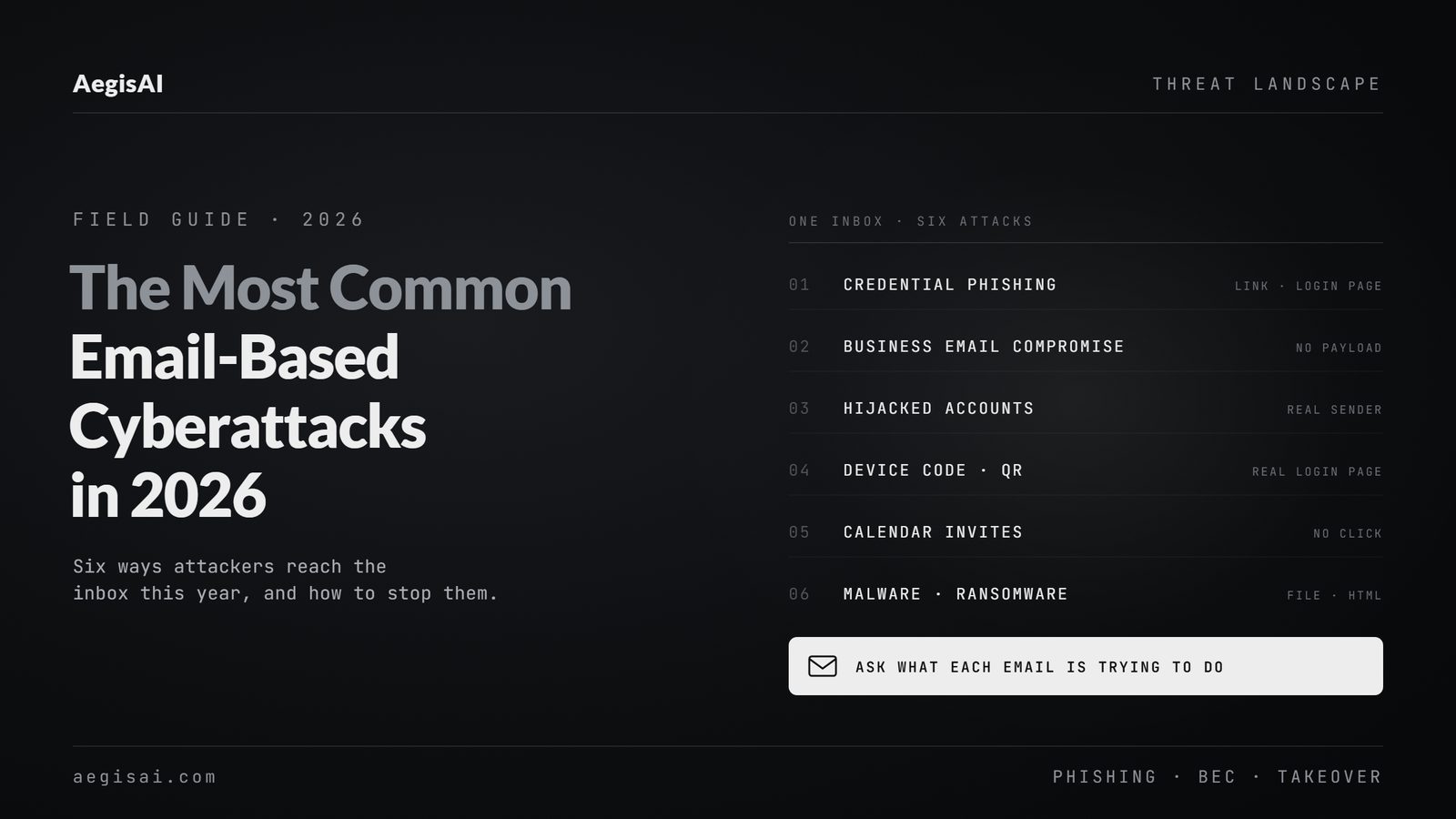
AegisAI Perspectives · 100
Stop business email compromise with three layers working together: phishing-resistant MFA, a call-back before bank changes, and a check on each request.
See it on your own Google Workspace or Microsoft 365 tenant. No MX change.
Or get the Q3 2026 State of the AI Attack report (free, instant download)
Stop business email compromise with layered controls: phishing-resistant MFA on finance and admin accounts8, out-of-band verification before any bank change, and mail analysis that reads the request15. The FBI's IC3 lists $3,046,598,558 in business email compromise losses for 202511. AegisAI's agents check every payment request against the sender's history.
IC3's 2025 report lists business email compromise losses of $3,046,598,558 for the year. Businesses also reported losses over $30 million to BEC scams involving AI in 202512.
A BEC message asks for a payment, a bank detail change or a payroll update, and it can come from a real, hijacked mailbox17.
Put the 2025 IC3 loss figure in front of finance leadership when you ask them to own the call-back rule.
Short on time? Watch the explainer, or book a demo.
DMARC stops one variant: it blocks spoofed email that fails alignment7. A hijacked vendor mailbox signs as itself, so its mail passes SPF and DKIM as well as DMARC17. NIST SP 800-177 gives the recommendations and guidelines for enhancing trust in email13.
They detect spoofing, malware and suspicious links or attachments before they reach users10. Whether your platform's own protection is enough on its own is the subject of is native email protection enough to stop BEC.
Enforce DMARC on every domain you own, and add a control that reads what the message asks for.
Run these steps in order.
Require phishing-resistant MFA for all users. Start with executives and with accounts in finance, HR or IT administration. Verify: the sign-in method report shows no finance or admin account signing in with a password alone.
Alert on sign-in anomalies such as logins from unusual locations, off-hours wire requests or sudden changes to vendor details9. Verify: an off-hours sign-in from a test account raises an alert.
Publish a DMARC policy that blocks spoofed mail failing alignment7. Verify: a spoofed test message from an outside server is rejected.
Keep gateway or platform filters on for the threats they were built for: spoofing, malware, suspicious links or attachments. Verify: a known test file is quarantined.
Require out-of-band verification for any bank detail change, vendor onboarding, payment reroute or urgent exception6. Verify: every change in the last month has a logged call.
Verify the sender address, especially on a mobile or handheld device, before acting on a request3. Verify: finance staff can show where the full address appears on their phone.
Add mail analysis that checks each payment request against the sender's history. Verify: a test request from an authenticated test mailbox is flagged.
Write the response into a runbook: the bank's fraud line and the IC3 complaint link4. Verify: two people in finance can find the runbook without help.
For Google Workspace admin settings, follow how to protect Google Workspace from business email compromise. Assign an owner to each of the eight steps and record the verify result next to it.
A call-back rule is a short written policy: no bank detail, payment routing or direct deposit change happens before out-of-band verification14. The FBI says the same: verify account change requests with the intended recipient through a secondary channel or two-factor authentication1.
The rule names four things:
Have the finance lead sign the rule, and audit ten changes a month against the call log.
The table maps what each one catches and what it leaves open, with the email layer's part in the last column.
| Control | Catches | Leaves open | AegisAI |
|---|---|---|---|
| DMARC at enforcement | Spoofed mail that fails alignment | Hijacked mailboxes that sign as themselves | Reads the request when authentication passes |
| Gateway and platform filters | Spoofing, malware, suspicious links or attachments | A request sent from a hijacked mailbox | Reads the sender's history and the change asked for16 |
| Mail removal after delivery | Copies of a flagged message in every mailbox that received it | Messages no verdict flagged | Median verdict 1.9 seconds, then removal from every mailbox18 |
| Call to a number on file | A fake bank detail change | Nothing in the mail flow | No edge: out-of-band verification is a finance process control |
60-second self-check
Six questions. Nothing is sent anywhere; the result shows on this page.
Next step: book a demo and bring this table with your own stack filled in.
Fill in this table for your own stack and fix the first row where "Leaves open" has no other control behind it.
Run one test per control each quarter and keep the results with the runbook.
Illustrative example, figures are fictional. A 250-person company tests its controls in one afternoon. A spoofed message from an outside server is rejected at DMARC. A test payment request from an authenticated internal test mailbox passes DMARC and the gateway, and the mail analysis layer flags it. A test bank change request reaches accounts payable; the clerk calls the number in the vendor master file and the change stops there. One gap appears: 3 of 12 finance accounts still sign in with a password alone, so MFA rollout becomes the first fix.
Set the next quarter's test date before you close this one, and send the results to the finance lead.
Call the bank first. The FBI tells victims to contact the originating financial institution as soon as fraud is recognised, to request a recall or reversal and a Hold Harmless Letter or Letter of Indemnity2. For a diverted salary, the employee contacts their own bank to request a recall and reports the irregular deposits to the employer5.
Then file a complaint with IC3, regardless of the amount; BEC victims use BEC.IC3.gov.
Print the bank's fraud line on the first page of the runbook today.
AegisAI reads the thread the way an analyst would: the sender's history, the change being asked for, and where the reply actually goes. A hijacked vendor mailbox signs as itself, so SPF, DKIM and DMARC pass. AI agents check every payment request against the sender's history, and stop the business email compromise that authentication lets through. The median verdict takes 1.9 seconds, then the email is removed from every mailbox that received it. Run AegisAI in monitoring mode on live mail with no MX change, then turn on removal19.
Track three numbers, each from a system you already run:
Review the three numbers with the finance lead at day 30 and close any account still on a password alone.
Layer the controls: phishing-resistant MFA for finance and admins, out-of-band verification before any bank change, DMARC for spoofed mail, and mail analysis that reads the request itself.
Only the spoofed kind. DMARC blocks spoofed email that fails alignment. A hijacked vendor mailbox signs as itself, so every authentication check passes.
Contact the originating financial institution as soon as fraud is recognised and request a recall or reversal. Then file a complaint at ic3.gov or BEC.IC3.gov, whatever the amount.
All users need it; executives come first, then staff in finance, HR or IT administration.
Use a secondary channel or two-factor authentication with the intended recipient, and make no system update before that out-of-band check.
IC3 recorded business losses over $30 million to BEC scams involving AI in 2025. Apply the same eight steps to those messages.