AegisAI Perspectives · 079
A financial firm should hold every emailed payment change and call the sender on a number already on file, since AI can fake both the email and the voice.

A financial firm should hold every emailed payment change and call the requester on a phone number already on file, never a number the email gives6. The FBI counts $55,499,915,582 in exposed business email compromise losses worldwide from October 2013 to December 20238. AegisAI checks each payment request against what the sender has sent before24, and the call-back rule covers the step that happens on the phone.
U.S. victims alone reported $20,089,561,364 in exposed losses across 158,436 cases in the same period26. The FBI warns that a cloned voice and a known contact can sound nearly identical7. Read the hub on what email security a financial services firm needs for the controls around this check.
FinCEN reports that criminals have used GenAI tools to impersonate an executive or trusted employee and instruct victims to pay accounts the scammer controls12. Since 2023, FinCEN has seen more suspicious activity reports from financial institutions describing deepfake media in fraud schemes.
The FBI warns that criminals use AI-generated audio of public figures or personal relations to elicit payments4.
In 2026, fraudsters used AI-generated messages and a cloned voice of senior executives and a top lawyer15 to get an Italian private bank to transfer about $108 million to overseas accounts.
The money also leaves fast and far. IC3 data shows BEC reported in all 50 states and 186 countries, with over 140 countries receiving fraudulent transfers28. In 2023, the FBI saw more BEC funds sent straight to custodial accounts held by third-party payment processors, peer-to-peer payment processors and cryptocurrency exchanges30.
Verify every request to change payment type or location before any money moves, as the FBI advises1. Set a second channel for verification, because the FBI warns against any request that is exclusively email based.
Put the changed account on hold in the payments system until step 5 passes. FinCEN notes that these transactions are often irrevocable, so funds cannot be recalled once sent14.
Use the phone number in the vendor master file or client record as it stood before the request. Never use a number from the email body or its signature block. The FBI says to independently identify a phone number for the person and call it.
If someone phones to confirm the change, hang up, look up the organization yourself and call that number directly5. Ask the contact to confirm the old account number and the invoice number the change applies to.
FinCEN lists two checks for emailed payment instructions: more than one means of communication, and contact with others authorized to conduct the transaction. Treat a familiar voice as unproven, since the FBI says a cloned voice and a known contact can sound nearly identical.
In Microsoft 365, run Set-ExternalInOutlook -Enabled $true to show external sender identification in Outlook22. Add finance approvers and executives to user impersonation protection in Defender for Office 36519. In Gmail, turn on protection against look-alike domains20.
Log who called, which number they used, where that number came from, and who gave the second approval. Release the hold in the payments system only when that log entry is complete.
Rate each check by one test: can the person who wrote the email also control the channel the check uses?
| Check | What the attacker controls | Holds against AI? |
|---|---|---|
| Reply to the request email | The thread and every reply | No |
| Call the number in the email or signature | The phone line that answers | No |
| Take an inbound call from the requester | The caller and a cloned voice | No |
| Call back on the number on file | Nothing, the firm chose the number | Yes |
| Second authorized person approves | Nothing, a separate person and channel | Yes |
| External and look-alike sender marking | The sender name and domain, which the tag exposes | Partly, it flags the email but proves nothing |
Illustrative example, figures are fictional: Larkspur Capital is a fictional wealth manager with a $240,000 custodian transfer due on a Friday. On the Tuesday before, its payments analyst gets an email from a long-standing custodian contact that quotes a real invoice number and says the receiving bank has changed. The email signature lists a direct line that does not match the vendor master file. Ten minutes later a caller who sounds like the contact phones the analyst and confirms the new account. Under step 4, the analyst ends the call and puts the $240,000 payment on hold in the payments system. The analyst then dials the contact's number from the vendor master file, recorded 14 months earlier. The real contact answers and says the custodian sent no bank change. A second approver signs the log, and the Friday transfer goes to the original account.
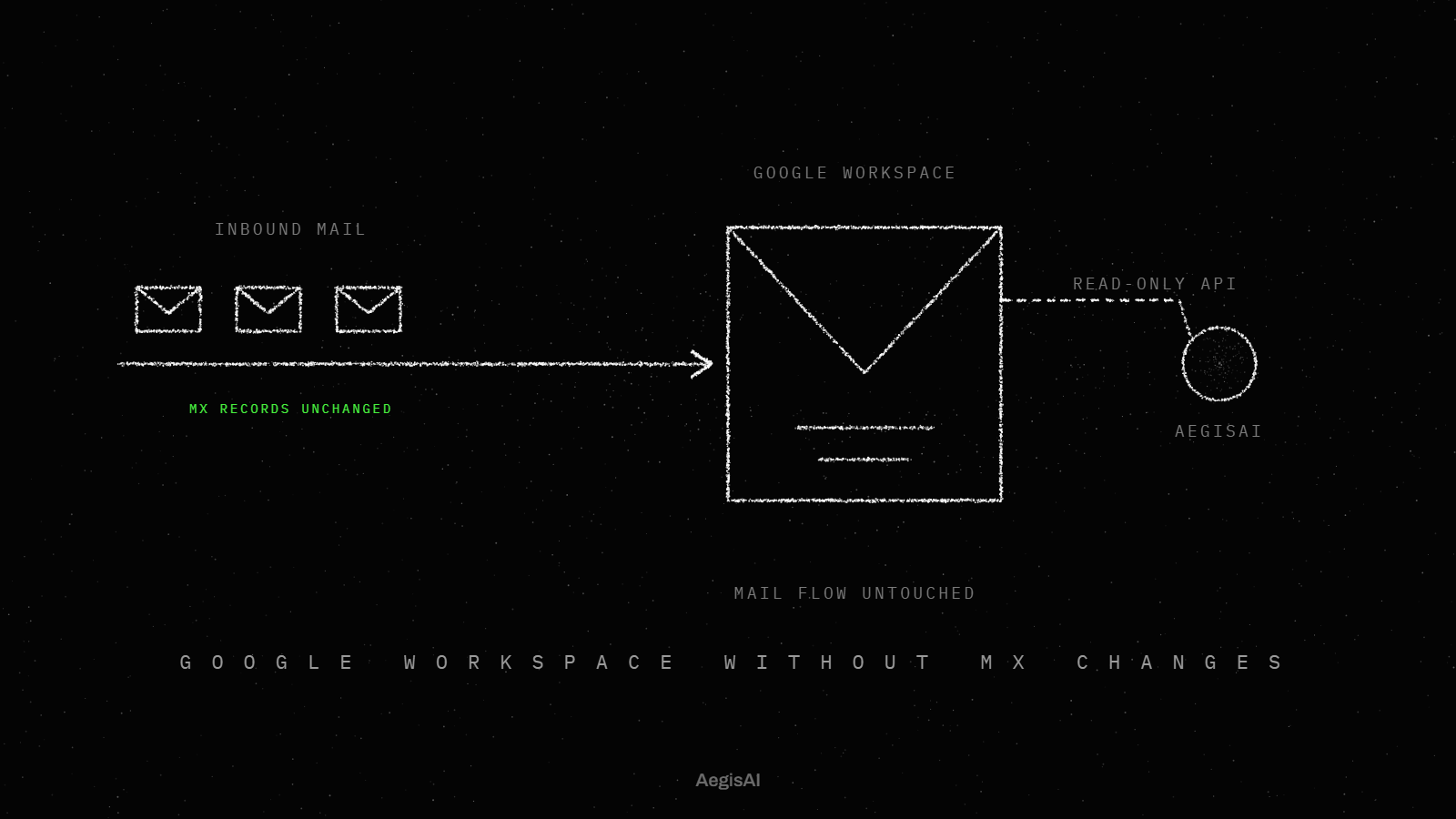
AegisAI connects by API and works after delivery23. Its verdict rests on what this sender has sent before and on the request itself. Every verdict arrives with the evidence, so an analyst can confirm it in seconds. A trial on your own tenant runs in monitoring mode on live mail with no MX change, then removal is turned on.
Track three numbers in the payments team log from the day the rule goes live.
Hold the payment, then call the requester on a number from your own records, never one from the email. Confirm with a second authorized person, and log both checks before releasing the funds.
No, because whoever wrote the email chose that number and answers it. The FBI says to independently identify a phone number for the person and call it.
It can pass an inbound call, because a cloned voice and a known contact can sound nearly identical. It cannot pass a call you place to a number on file, because the attacker does not control that line.
The FBI counts 305,033 incidents and $55,499,915,582 in exposed losses worldwide from October 2013 to December 2023. Identified global exposed losses rose 9% between December 2022 and December 2023.
FinCEN issued an alert in November 2024 after more suspicious activity reports described deepfake media in fraud against financial institutions. It names GenAI impersonation of executives to direct payments.
In Microsoft 365, external sender identification in Outlook and user impersonation protection, up to 350 users per policy. Gmail offers protection against look-alike domains.