Today we are releasing Proteus, the first model from the AegisAI Lab. Proteus is a foundational model trained on email, and it detects attacks by investigating them. It doesn’t rely on rules or behavioral patterns. It checks the claims each message makes against evidence the sender does not control. Proteus does this for every message, every time.
AegisAI began with an observation our founding team made at Google: the diversity of the email attacks we saw every day was accelerating, and detection rules and behavioral models could not keep pace. Over the past year we moved from prompting frontier models, to tuning and then training open-weight models. Each step helped. None had the task specificity needed against attackers who are themselves using generative models. So, we trained our own model, from the ground up.
Watch Ryan Luo and Yogesh Patil on Proteus · 1:55
30x Fewer Missed Attacks, 7x Faster Verdicts
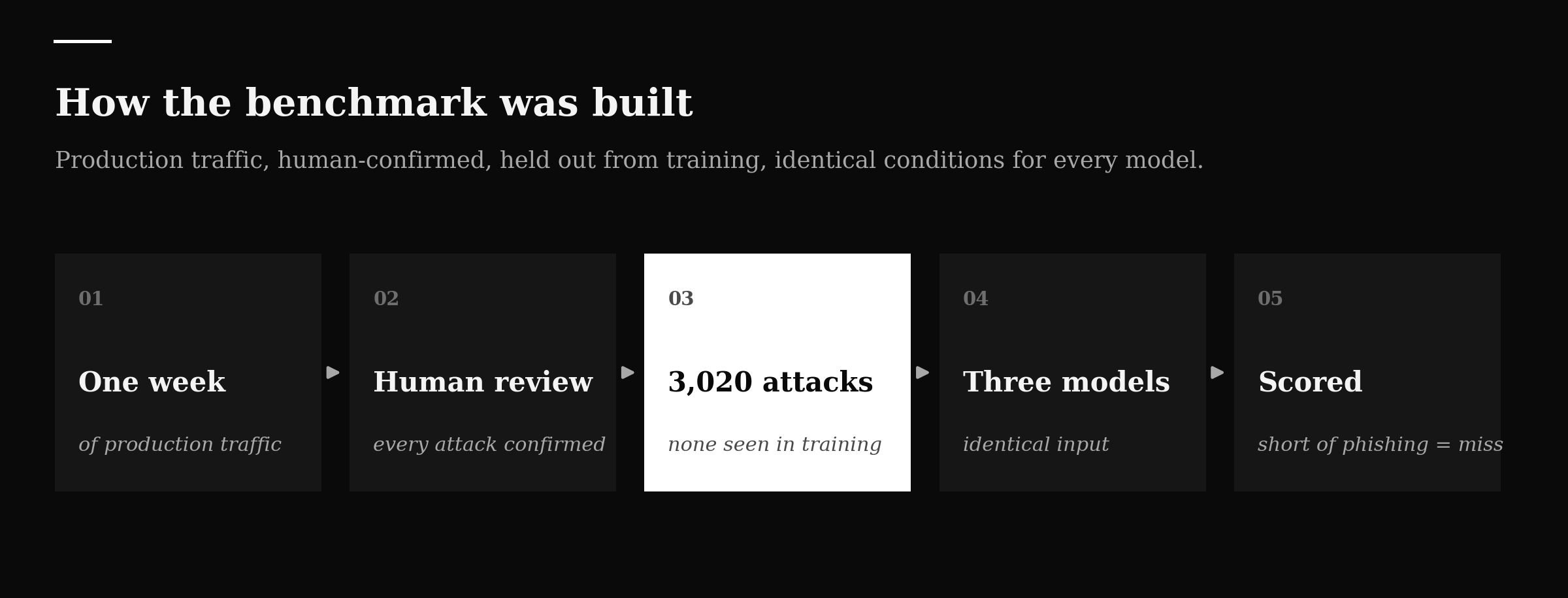
Investigating every attack is what makes the difference in detection. On a benchmark of 3,020 human-reviewed phishing attacks drawn from one week of production traffic, Proteus identified more than 99% of attacks. A leading closed-source general-purpose model identified 81.3%, and a widely used open-weight model 80.0%. Each general model let through roughly thirty times as many attacks as Proteus. Proteus was also faster. Against the closed-source model it returned its verdict 7.2x sooner at the median, and 26x sooner in the slowest 1 in 20 cases.
The general models received the message and a plain classification instruction, which is what a security team gets when it points one at its mail. That makes the comparison realistic, but it is not a measurement of the most those models could be made to do. We set out what this evaluation does and does not establish in the Limitations section.
Fewer missed attacks, faster verdicts
Proteus against general-purpose models on 3,020 held-out, human-reviewed attacks. Share of attacks missed.
Speed is relative to Proteus, measured against the leading closed-source model.
Attacks are now written by machines
For most of the history of email security, novelty was expensive for the attacker. A convincing pretext, tailored to one company and written in flawless prose, took human effort, so a campaign had to be reused across many recipients to pay for itself. That reuse was the defender’s principal asset: an attack could be observed once, characterized, and blocked everywhere else.
Generative models have removed the constraint. Across 2025, AI-generated spear phishing grew from less than 1% to over 20% of the phishing AegisAI observed, and on its current trajectory it approaches the majority of attacks by 2028. It also works. In a controlled study, fully AI-automated spear phishing drew the same 54% click-through rate as messages written by human experts, against 12% for generic phishing. A message tailored to its recipient now costs close to nothing to produce, and each one is a first occurrence.

Why email security needs its own model
The decision to train a model rather than build on top of one came from a class of attack that established methods handle poorly. They do not fail because they are badly implemented. They fail because of what they take as input.
A representative case: a customer’s Google Workspace account was taken over through a malicious OAuth grant and began sending bid invitations to that customer’s suppliers. Every message passed SPF, DKIM and DMARC, because every message was in fact sent by the account it claimed to come from. Authentication was working exactly as specified. AegisAI flagged the first of these messages 89 minutes before the account-takeover alert fired.
Authentication was not the control that failed here. It was the control that confirmed the attacker’s access. The first attack message was quarantined well before any account-level signal existed, because Proteus did not wait for the account to look compromised. It investigated the message itself, and the evidence around it did not support what the message claimed to be.
Three methods, three failure modes
Production email security is assembled from three families of method. Each fails on the case above for a different reason, and in each case the reason is structural. What they share is that each recognizes the present by comparing it with a memory of the past.
Rules and signatures
A rule encodes a property observed in an attack that has already been seen and classified. Inside the space of that property a rule is exact and inexpensive. Outside it a rule has no behavior at all: generalization is not weak, it is zero by construction. That was an acceptable trade while writing a variant of an attack and writing a rule against it were both human-rate activities. Generative models have made the first machine-rate while the second remains human-rate, and the loop no longer closes.
Rulesets also accumulate a cost that is rarely attributed. Each rule narrows the space of delivered mail, and the false positives that result are spread across the ruleset rather than charged to the rule that caused them. A mature ruleset is therefore hard to unwind, because no single rule can be shown to be the expensive one.
Anomaly and behavioral detection
The second family learns a model of normal activity per sender, per recipient and per organization, and flags departures from it. This is where most machine learning in email security is applied today, and it inherits two problems well documented in the intrusion-detection literature.
The first is the base rate. Attacks are rare relative to legitimate mail, and rare events are unforgiving of false positives in a way accuracy figures conceal. If one message in ten thousand is an attack, a detector with 99% detection and a 1% false-positive rate produces an alert stream in which fewer than one alert in a hundred is real: roughly 102 false alarms for every true one. The binding constraint on a deployed detector is almost never its detection rate. It is the false-positive rate required to make that detection rate usable. Axelsson set this out for intrusion detection in 2000, and email presents a less favorable base rate than the systems he described.
The second is what Sommer and Paxson called the closed-world assumption. Machine learning reliably recognizes what resembles its training distribution; anomaly detection asks for the opposite, to identify what resembles nothing seen before. The variance of benign mail compounds the problem. Notifications, marketing, forwarded threads, mailing lists and people who simply write unusually mean that “normal” is not a tight distribution to depart from, and the gap between statistically unusual and malicious has to be closed by something. In practice, that something is an analyst.
In email these problems take a particularly costly shape. The baseline is learned from a sender’s own history, which places the method’s blind spot exactly where losses are largest. A hijacked mailbox writes from inside the baseline that was learned from it. A first contact has no baseline to depart from. Together they describe the typical high-severity enterprise attack, and because additional data is drawn mostly from cases the method already handles, collecting more of it does not close the gap.
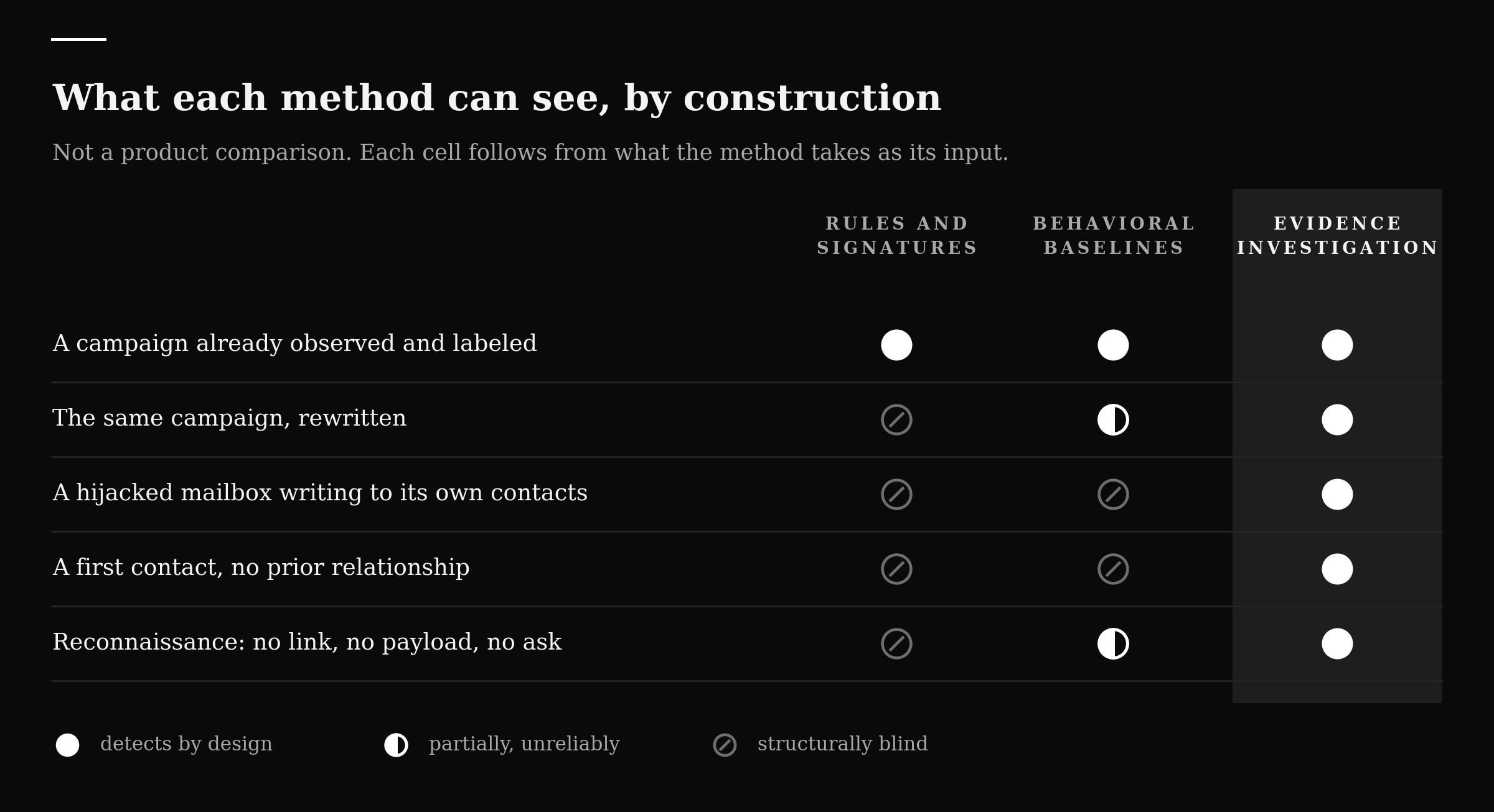
There is an adversarial consequence as well. A baseline treats observed history as ground truth, so an attacker holding a compromised account can move it deliberately, in steps that are each unremarkable, until the behavior they intend falls inside it.
Supervised classifiers on engineered features
The third family trains a classifier on features an analyst has specified: domain age, link count, keyword presence, authentication results, attachment type. The feature set encodes the analyst’s model of attacks at the moment it was written. When attacks change, it is the features rather than the weights that go stale first, and refitting cannot recover what the features cannot express. Confirmed attack labels are scarce and costly, which limits how quickly the classifier can move. And because campaigns are highly self-similar, a random train-test split places near-duplicates of the same campaign on both sides and reports a number that does not survive contact with production.
Moving from General Purpose to Task Specific
Pointing a frontier model at the mail stream is the reasonable next thing to try, and we tried it before training anything. Three properties work against it.
Instruction-following. General-purpose models are trained to be cooperative with the text placed in front of them, which is precisely the disposition a phishing message is written to exploit.
Email representation. Proteus is trained to interpret an email classification as a structured entity. Our representation brings together the message body, relevant headers, historical context, sanitized URL and attachment context, and threat intelligence. We trained the model to operate on this representation and introduced custom tokenization alongside it. The central choice is not how we divide the text into tokens, but what we teach the model to interpret: a message, its context, and the relationships between them. This both saves on token cost and improves model accuracy, which we discuss in later sections.
Availability. A model anyone can query is a model an attacker can probe offline, repeatedly and undetected, until a message passes. A model that is not public offers no such affordance.
Investigating every message
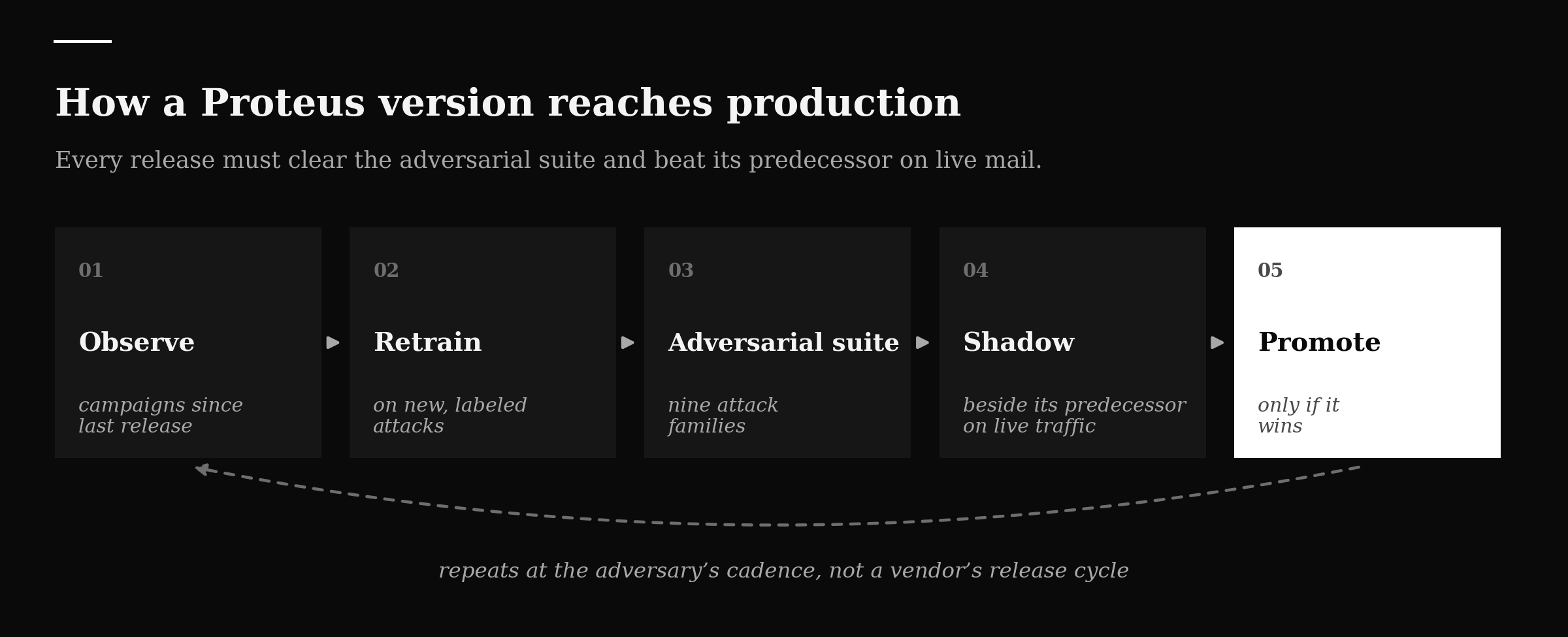
Three things follow from training our own. A model pretrained on email learns its representation from traffic far larger than any labeled attack set, which is the scarce resource. It can be retrained at the rate the adversary mutates, not the rate at which an analyst can specify features. And, most importantly, it can be trained to investigate rather than to recognize, which is the subject of the next section.
Every method described above asks some version of the same question: does this message resemble something already known? When the attack is new, rewritten or sent from a legitimate account, the honest answer is no, and the message is delivered. Proteus asks a different question.
A baseline asks whether a message is unusual. Proteus asks whether the evidence supports the claim the message makes about itself.
The first question has no answer for a hijacked mailbox, because the message is not unusual. The second question does. It has an answer for every phishing message, because a phishing message has to make claims to work. It claims to come from a particular party, to continue a relationship, to point somewhere legitimate, and to be a step in a process the recipient knows. Each of those claims can be checked against something the attacker cannot author: where the link actually resolves, whether these two parties have ever corresponded, what the route and headers record, and what the sending infrastructure has done elsewhere. None of those checks requires that the attack has been seen before.
Security teams already know that investigation works. It is how an analyst confirms an attack. The limitation has always been scale: a person can investigate a handful of messages a day, so conventional stacks score all mail on resemblance and reserve investigation for the few that get flagged, usually after the fact. Proteus removes that trade-off. Investigation is not an escalation path. It is how every message is assessed.
Investigation on every message
Conventional stacks score all mail and investigate the exceptions. Proteus investigates everything.
TRIAGE — HOW MOST EMAIL SECURITY WORKS
Score everything, investigate a few, after the fact
PROTEUS — INVESTIGATION ON EVERY MESSAGE
Every message investigated, inline, before it reaches a person
Schematic. Illustrates where investigation happens in each approach, not measured volumes or times.
Consider the hardest case in our benchmark, a reconnaissance message. It carries no link and no attachment, it passes authentication, and it asks only for a reply. A content filter has nothing to examine.
Are you at your desk this morning? There is something I need handled quietly before Thursday. Let me know when you get this.
Anatomy of an investigation
The reconnaissance message above has no link and no payload. Proteus decides what to check as it goes.
EACH FINDING DECIDES THE NEXT CHECK
active pathconsidered, not pursued
- 01Read messageClaims a board member; asks for discretion
- Link resolutionno links present
- Attachment analysisno attachments
- 02Sender historyNever written from this address
- 03Known identitiesBoard member’s known address is not this one
- Infrastructureauthenticates; adds little
- 04Thread historyNew thread, no prior context between them
- 05Request patternSecrecy + deadline + reply-first: BEC pretext
- Payment detailsnone requested yet
- VERDICTPhishingBEC reconnaissance
EVIDENCE AGAINST THE MESSAGE’S CLAIMS
Illustrative reconstruction of one run. A different message, or a different finding at any step, produces a different path.
Investigated, the message falls apart. A board member who has never written from this address, a new thread with no history behind it, a request for discretion paired with a deadline, and authentication that proves only that someone controls a personal mailbox. No single fact is conclusive. Together they do not support what the message claims to be, and the verdict follows from the evidence rather than from resemblance to anything seen before.
The rest of this post describes how Proteus is built to do this, and what it does to detection when it is done on every message.
Model and training
Evidence ablation
We tested three configurations that differ in one variable: evidence trained into the model, evidence supplied at inference, and no evidence. Supplying evidence at inference identified 8.4% more phishing than serving none. This is the most direct measurement in this post of what investigation contributes: the same model, with and without the ability to check what a message claims. Training it in performed slightly worse than omitting it altogether. We do not have a complete account of that second result. Our working explanation is that training on evidence teaches the model to reconstruct it from the message rather than to consult it, which is to say, to recognize rather than investigate.
Consulting evidence beats memorizing it
Three configurations, one variable, scored on the same pinned message set.
Change in phishing identified, relative to serving no evidence.
Calibration
Most models today are tools to aid in decision-making, but don't make the actual decision. These models can produce a confident answer even without necessarily being correct, which makes them impossible to use in a classification context. AegisAI calibrates our models by examining internal activations and measuring how those signals relate to ground-truth outcomes. This gives us an estimate of a decision’s reliability that is separate from how confidently the model states it. The same signals help identify cases where prompt injection has shifted the model away from its assigned task.
One practical note for anyone reproducing this: fit calibration on the quantized serving model rather than the training stack. Fitting on the training stack leaves a shift that surfaces later and is easily misread as drift.