AI vs Rule-Based Email Security: Can It Stop Phishing?
Rule-based email security misses novel phishing attacks. See how AI-native detection catches what static rules cannot, based on real evaluation data.
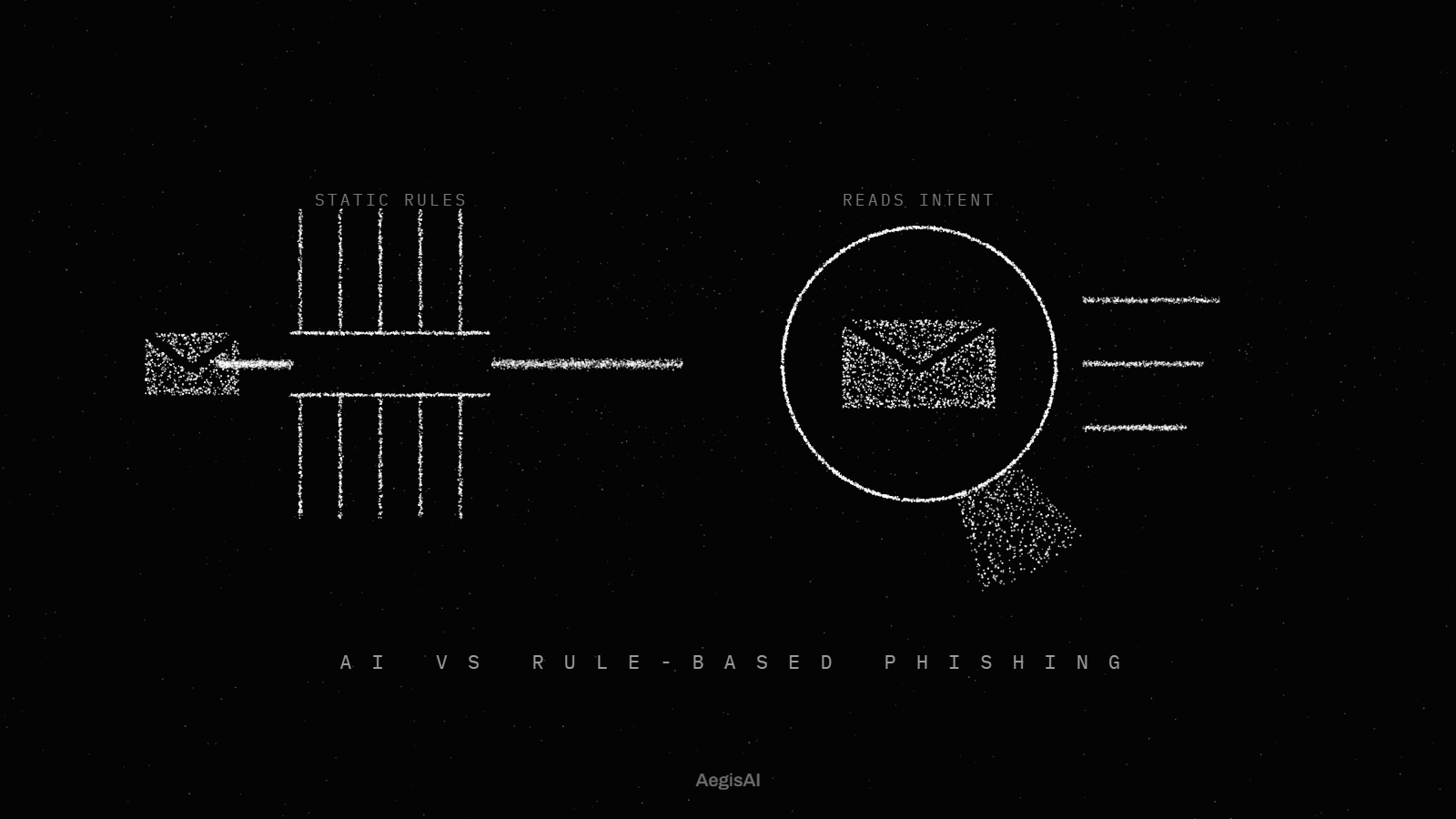

Yes, in evaluations, AI-native email security has caught credential-theft and role-targeted phishing attacks that rule-based gateways missed, because it analyzes intent and context instead of matching known patterns. Rule-based systems flag what they have seen before. AI models reason about unfamiliar attacks the way a trained analyst would.
Key takeaways
- Rule-based filters match known patterns. They cannot evaluate an email they have never seen before, only compare it to a library of past examples.
- Tightening rules reduces missed attacks but increases false positives that land in quarantine for manual review.
- In a reported evaluation, Writer saw a 26% increase in recall over its existing stack after adding AI-native detection, with zero rules or configuration written by Writer, according to AegisAI's Writer customer story.
- At the time of that evaluation, 19 credential-theft attacks were reported live in inboxes, according to the same source.
- AI-native detection produces evidence-backed verdicts on novel, role-targeted attacks rather than relying solely on signature or keyword matching.
Why do rule-based filters miss new phishing attacks?
A rule-based filter works by comparing an incoming email against a list of known indicators: flagged domains, specific keywords, sender reputation scores, attachment hashes. If an attack does not match an entry on that list, the filter has no basis for a verdict.
As one evaluation put it, "a rule cannot tell a real invoice from a fraudulent one, only a familiar pattern from an unfamiliar one." Attackers do not need to break new ground technically to bypass a rule. They only need to make an email look unfamiliar enough that it does not match an existing pattern.
This is also why rule-based phishing detection limitations show up most clearly with targeted attacks. A mass-spam campaign reusing the same template across thousands of inboxes is exactly the kind of threat rules are built to catch. A single, carefully worded email impersonating a CFO, with no link and no attachment, is not.
The tuning tradeoff
Security teams managing rule-based systems face a recurring operational problem: there is no setting that minimizes both missed attacks and false positives at the same time.
| Rule setting | Effect on missed attacks | Effect on false positives |
|---|---|---|
| Tightened | Fewer real attacks reach the inbox | More legitimate mail lands in quarantine for manual release |
| Loosened | Less legitimate mail gets blocked | More real attacks reach the inbox |
As the evaluation summarized it: "Tighten it, and legitimate mail lands in quarantine for someone to release by hand. Loosen it, and real attacks reach the inbox." There is no fixed point on that dial that solves both sides of the problem, because the dial only adjusts sensitivity to known patterns. It does not add judgment.
What did Writer's evaluation show about AI vs rules?
Writer ran its existing email security stack alongside AegisAI's AI-native detection to compare results directly. According to the Writer customer story, the evaluation reported:
- A 26% increase in recall over the existing stack.
- 19 credential-theft attacks live in inboxes at the time of the report.
- Zero rules or configuration written by Writer to achieve those results.
Zero configuration is the operational difference. A rule-based system requires a security team to write, test, and maintain rules as new attack patterns emerge. An AI-native system is evaluated on how it performs out of the box against attacks it has not been explicitly tuned to catch.
Note: these figures are drawn from AegisAI's own customer-facing report. Readers evaluating vendors should request the underlying evaluation methodology directly, and any reuse of these figures in sales or marketing contexts should go through legal and product review.
How does AI-native email security differ from pattern matching?
The core difference is what the system produces as output. A rule-based filter produces a binary match or no match against a known indicator. AI-native email security is designed to produce a verdict backed by evidence: why a given email looks like an impersonation attempt, what role or workflow it is targeting, and what specific signals drove that conclusion.
Role-targeted attacks are the hard case for novel phishing attack detection. A payload-free business email compromise attempt, impersonating a vendor or executive with a request to change payment details, has no malicious link or attachment for a scanner to flag. AegisAI's own comparison of AI or rule-based approaches to payloadless BEC covers this gap directly: these attacks are built specifically to not trip a pattern-matching system.
Does AI email security reduce false positives too?
False positives are not a side effect of strict rules. They are a structural outcome of how rule-based matching works. When a filter cannot distinguish intent, it over-flags anything that resembles a past attack pattern, including legitimate mail that happens to share surface characteristics.
AegisAI's analysis of the root causes of email security false positives traces this back to the same limitation described above: a system built on matching cannot separate a familiar pattern from a legitimate email that happens to look similar. Reducing false positives in a rule-based system usually means loosening rules, which reopens the door to missed attacks. An AI-native system that evaluates context and intent is not subject to the same tradeoff curve, because it is not deciding based on surface similarity alone.
Is this a gateway problem or an architecture problem?
A common fix is a stricter gateway or a better block list. Industry threat research points to a problem that configuration does not solve. CYFIRMA's April 2026 weekly intelligence report recommends that organizations "augment built-in email security with layers that take a materially different approach to threat detection," rather than relying on a single filtering layer tuned the same way as the one before it, according to CYFIRMA's weekly intelligence report.
That recommendation lines up with AegisAI's own comparison of secure email gateways: a gateway is an architecture built around filtering known-bad traffic, not reasoning about intent on a message it has never classified before.
Why is this gap getting more urgent?
Phishing attacks are becoming harder for pattern-based systems to catch, not easier. A joint FBI and CISA advisory published in October 2026 warned that threat actors are using AI to polish phishing and smishing lures targeting election and campaign officials, noting the lures "have become more convincing" compared to past cycles, according to the FBI and CISA joint advisory. The advisory's core recommendations, phishing-resistant multi-factor authentication, strong gateway filtering, and a clear employee reporting process, reflect a layered approach rather than reliance on any single control.
Separately, ConnectWise's 2026 threat report describes how AI-enabled phishing attacks let threat actors "rapidly generate convincing lures at scale, closely mimicking legitimate users, communications, and workflows," making phishing "more accessible, more effective, and more difficult to detect," according to ConnectWise's 2026 cybersecurity threats report. And training guidance from usecure notes that AI is "scaling social engineering" while attackers increasingly exploit authentication flows directly rather than relying on static credential theft, according to usecure's 2026 security awareness training topics.
The common thread across these sources: attacks are changing shape faster than static rule libraries can be updated to match them.
Rule-based vs AI-native detection: a direct comparison
| Capability | Rule-based systems | AI-native systems |
|---|---|---|
| Detects known attack patterns | Yes | Yes |
| Detects novel, unseen attacks | No, requires a matching rule first | Designed to evaluate intent without a prior match |
| Requires ongoing manual tuning | Yes | Minimal, per Writer's reported zero-configuration result |
| Produces explainable verdicts | Limited to which rule triggered | Evidence-based reasoning per message |
| False positive tradeoff | Tightening rules increases false positives | Not governed by the same tightening/loosening tradeoff |
Frequently asked questions
Does AI email security replace the need for rules entirely?
Not in every environment, but the evaluation data from Writer shows AI-native detection can perform well without customer-written rules or configuration. Some organizations still layer in basic allow/block lists for specific operational needs.
What makes an attack "novel" versus a known pattern?
A novel attack has no prior match in a rule library: a new sender domain, a new wording style, or a new targeted role that has not been flagged before. Rule-based filters have no reference point for these. AI-native systems evaluate the message's intent directly.
Why do false positives matter for security teams?
Every false positive requires someone to manually review and release a quarantined email. At scale, this creates alert fatigue and slows down legitimate business communication, which is one reason tightening rules is not a cost-free fix.
Is rule-based detection obsolete?
No. Rule-based matching still catches known, mass-distributed threats efficiently. The gap is specifically with unfamiliar, targeted attacks like payload-free business email compromise, which rule-based systems were not designed to evaluate.
How is recall measured in an email security evaluation?
Recall measures the percentage of actual malicious emails a system correctly identifies out of all malicious emails present. The 26% recall increase reported in the Writer evaluation reflects performance against the same attack set as the existing stack, according to AegisAI's customer report.
See the gap in your own inbox
Rule-based systems cannot evaluate what they have never seen. If your team is still tuning rules after every new attack pattern, that cycle will not end on its own. Book a demo to see how AI-native detection evaluates novel, role-targeted phishing attempts without manual rule configuration.
Related posts
More from the AegisAI blog.